 Background
Sixty years ago on August 21, 1958 Prime Minister Diefenbaker announced in the House of Commons the establishment of what became the basis for the Continuity of Government Program (see Hansard of that date for more specifics).
“There is therefore a need, in our opinion, for the development ofadecentralizedfederalsystemofemergency government with central, regional and some zonal elements. We intend to provide for a suitable central authority and to establish provincial, regional and zonal organizations through which a large amount of the work of the federal government could be carried on in time of war by the necessary delegation of authority to federal officers.”
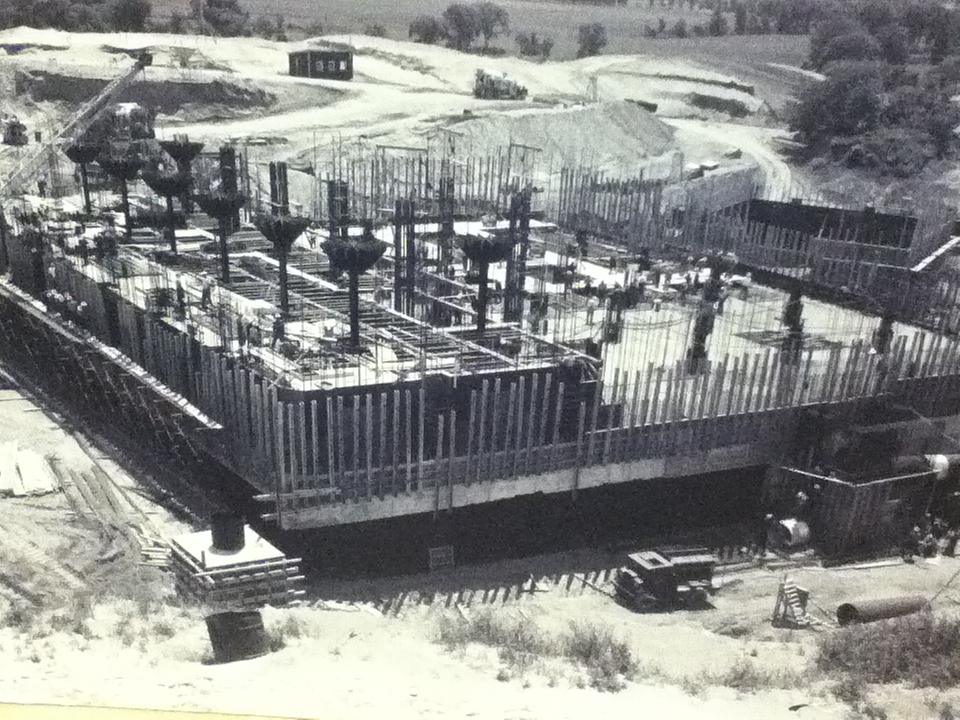
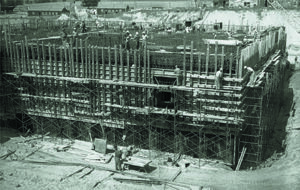
Construction of the Carp facility (then designated by the deliberately misleading title Experimental Army Signals Establishment or Project EASE for security reasons) began in 1959. The Cold War was heating up at the time and there was a great deal of urgency to expedite completion of this project. Thus the usual somewhat ponderous government processes had to be sped up in order to ‘get on with it’.
There were three primary agencies involved in this massive defence construction effort. The Department of National Defence (DND) was the funding and requirements definition authority, On DND’s behalf Defence Construction (1951) Limited (DCL) was the contracting authority and the Foundation Company of Canada was the actual engineering design and construction contractor,
Overall Management
DND’s designated Project Manager was a no-nonsense Royal Canadian Engineer “Works” officer, Lt Col Ed Churchill (who during WWII had constructed forward battlefield airfields up the length of Italy). He went on to be the Project Manager for EXPO 67 after completing the then very hush-hush EASE project. Lt Col Churchill appears having a discussion at a meeting shown in the film produced for Foundation Company about its construction, “The Nuclear Roof”.
Contracting
The Crown corporation DCL was selected as the contracting agency as it had already done well on a number of government / defence projects. It had been created in 1951 to help build massive defence infrastructure during the Cold War. DCL was notably involved in building the Distant Early Warning Line. It later became Defence Construction Canada (DCC) with essentially the same mandate. Its only client is the Department of National Defence.
The following is an extract from the history section https://www.dcc-cdc.gc.ca/english/history/of the Defence Construction Canada website where they list and describe some of the many projects that they have been responsible for contracting matters (including the bunker).:
“1961 – The Experimental Army Signals Establishment (EASE) Commonly known as the Diefenbunker, EASE is built in Carp, Ontario between 1959 and 1961 to shelter Canada’s leaders in the event of nuclear war. It is designed to resist a 5-megaton nuclear weapon detonating 1.1 miles away, resulting in a 100,000-square-foot, four-storey structure surrounded by a layer of gravel five feet thick. Operated by DND from 1959 to 1994, the Diefenbunker is opened to the public as a museum in 1998.”
In 2012 DCC published a book entitled “ Breaking New Ground” which has as its cover a photo of the EASE site under construction. On page 33 of that document is an article entitled “Going Underground” describing DCL’s role in construction of the ‘EASE bunker’ and the various BRIDGE Sites (regional bunkers) across the country. DCC maintains its’ corporate headquarters on Albert Street in Ottawa.
Construction
The Foundation Company of Canada was the primary design and construction agency. Sometime in the late 60s or the 70s (?) the Company became part of Aecon, a large Canadian engineering design and construction firm.
On a history page of its website Aecon noted some of the various companies that have become part of its organization. (2024: Some of this information can now be found at Wikipedia.)
“Aecon’s predecessor companies include some of Canada’s most renowned construction names. Over the years, companies such as The Foundation Company of Canada, Jackson Lewis, Lockerbie and Hole, Banister Pipelines, Nicholls-Radtke, Pitts Engineering Construction, and Armbro Construction have come together to form what we now know as Aecon.”
The bunker is not mentioned specifically as one of the Foundation Company of Canada’s /Aecon’s achievements probably because of the high level of security concerns involved in even admitting to its very existence. As an aside even today some former employees involved in the construction of the bunker refuse to discuss the project, citing security as their reason.
A Thought…..
Considering the above information it is evident that both DCC and Aecon are proud of their respective engineering histories including the building of the Carp bunker. Since they both had major roles in its construction, they may be amenable to helping us to maintain a significant component of their legacy re-purposed as a museum for future generations to learn about the Cold War.