INTRODUCTION
The following narrative records my understanding of the events the led up to the cancellation in 1992 of most of the arrangements that were in place to support the Civil Defence aspects of Emergency Preparedness in Canada including the Continuity of Government (CoG) Program. The term ‘Civil Defence’ (CD) refers to that portion of civil emergency preparedness activities that (starting in the 1950s) had been put in place by the federal government to respond to a potential nuclear attack on North America. This latter program encompassed the extensive federal system of government shelters, including the Central Emergency Government Headquarters lodged at Canadian Forces Station CARP. This document is being written to respond to queries that the Diefenbunker, Canada’s Cold War Museum has recently received from federal officials concerning the closure and disposal of the facilities aspects of the CoG, as well as to provide a record for the Diefenbunker museum’s archives.
AUTHOR’S BACKGROUND
Because of my long time managing the CoG/CoCG Program and my continuing involvement in the CARP building as a volunteer member of the Board of Directors with the Diefenbunker Museum, I consider myself reasonably qualified to compose this narrative. From 1983 when I retired from a career with the Canadian Army and became the Director of Emergency Operations Coordination (DEOC) with EPC to 1997 when I retired as Acting Director General Operations I was the person primarily responsible for the overall operational readiness and functional coordination of the CoG Program and (until 1992), its successor, the CoCG Program. While the CoG/CoCG Program(s) involved many departments and agencies of the federal, provincial and, indirectly even municipal governments and some elements of the private sector (i.e. telecommunications), its primary ‘champion’ was EPC and within that organisation, a few officials in DEOC.
DISCLAIMER
The information contained in the document is mainly based on my memory of events, prompted by a few relevant documents that I’ve been able to find and conversations with fellow “EPC veterans” who were involved in the Program. There is probably a great deal of other information that is (or was) classified or is buried somewhere in files/archives that could be useful in shedding additional light on the events pertaining the closure and that would add to (or conflict with/contradict) my version as to what happened. If such is the case I apologize in advance. I don’t believe that once DND had decided to go ahead with the closure, EPC officials were kept fully ‘in the picture’.
This narrative should be treated as a draft. I will staff it around to several of the Museum’s volunteers and other persons who may have knowledge of the matter and as updating, supplementary or correction information is provided I will modify the document and redistribute it as required.
LEGAL and LEGISLATIVE BACKGROUND
In its latter years of operation (post Parliamentary passage of the Emergency Preparedness Act (EPA) in 1988), the CoG was in the process of being superseded by a Continuity of Constitutional Government Program (CoCG). In the EPA, CoG had been replaced by CoCG. Post the Act Emergency Preparedness Canada officials began attempting to clarify and respond to the practical implications of the term constitutional insofar as it impacted the practical preparedness and operational readiness of the physical facilities and the operational procedures aspects of the Program. After some consultation with constitutional experts, by about 1990 it had been concluded that (at the least) a quorum of the House of Commons (20), the Senate 15), the Supreme Court (4?) and the Federal Court (4?) would have to be provided for in the CoG protected facilities. (The quorum approach seemed to be the most reasonable and practicable course-of action given the severe physical size limitations of the then existing extensive system of very-expensive-to-construct nuclear hardened ‘bunkers’ located across the country).
ORIGINS of the CoG PROGRAM and the EMERGENCY GOVERNMENT HQs
Many details of the CoG including its origins and ‘evolution’ during the three and a half decades of its existence may be found in documents posted on the Diefenbunker’s web site www.diefenbunker.ca. Copies of many other related background documents have already been provided to Public Safety and Emergency Preparedness Canada officials currently responsible for the CoCG Program. In summary the CoG Program (and its nationwide system of hardened shelters) was announced in Parliament in 1958 (reference the appropriate Hansard records) by the Diefenbaker administration. This announcement (and subsequent related statements) in the House of Commons appears to have followed Cabinet level discussions by senior bureaucrats and elected officials in response to the then rapidly growing threat of a potential Soviet nuclear attack on North America. The Central Emergency Government Headquarters (CEGHQ) and other related Regional and Zonal EGHQs were an integral part of those arrangements and an essential component of the panoply of Civil Defense preparations then being put in place across the nation. The bulk of CoG preparation revolved around the system of hardened shelter facilities.
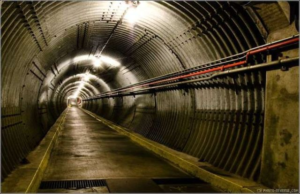
The CARP Facility was constructed in 1959-61 by the Foundation Company of Montreal, supervised by officers from the Canadian Army’s Engineering and Signals Corps. It was fitted up with tele-communications equipment and commissioned by 1962 (or 1963). The existence of this CEGHQ and its real primary purpose as a CoG shelter for federal government officials was a badly kept secret as a result of a infamous newspaper article published during its construction. However military officials continued to refer to it as an Experimental Army Signals Establishment (EASE) site (for security reasons!).
Soon after its commissioning, a series of national “TOCSIN” exercises were held in the early 1960s to trial the CARP facility and test related preparations. It is believed that the CARP facility was operationally ready, both with respect to military telecommunications and civil federal government CoG headquarters aspects, when the Cuban missile crisis occurred in October 1962. However it appears (from interviews with the then Commanding Officer and other sources) very little in the way of actual crisis-related activity actually took place at the CARP facility.
The CEGHQ was the location from which the overall governance functions of the federal government would have been coordinated/directed. There was, however a need for shelter (fallout, not blast resistant) facilities in the regions to enable federal regional officials and provincial governments to also continue functioning. This included coordination of combined federal/provincial coordination of survival operations such as re-entry, rescue, medical and other such direct help-to-the-affected-survivors activities. Thus in 1961 work had begun of a series of Regional Emergency Government Headquarters (REGHQ) ‘bunkers’ for combined federal and provincial officials. These facilities, while ‘reporting’ to the CEGHQ, had a quite different set of functions. Six out of a planned ten of these facilities were completed by 1968 when the Trudeau administration put the entire Civil Defence program on hold (with the provision that arrangements already in-place be maintained at a reasonable level of operational readiness). This decision took place during a period of relative quiet during the Cold War.
PERIOD of CoG/CEGHQ INACTIVITY
It is my understanding that civil CoG activity at the CARP Facility was virtually non-existent during the mid 1960s to late 1970s period. The military continued to maintain the facility and to use it as a major component in its telecommunications capabilities.
The general lack of any CoG related activity by the CD oriented Canada Emergency Measures Organisation (EMO) and its successor EPC was likely due to a number of factors. There was a (puzzling) lack of available CoG ‘doctrine’, directives, and other such documentation that one would expect to accompany such an expensive-to-create program (secrecy may have been one reason for this, the other being ignorance and lack of motivation by the officials responsible). As well for much of this time an uneasy detente/stalemate prevailed between the nuclear powers which may have, in the short-sighted view of some officials, led them to conclude that the program was no longer needed. Furthermore an general attitude of malaise toward CD preparations (‘we’re all going to die, life won’t be worth living, better red than dead, etc.’) became wide spread amongst the general populace which may have influenced in the attitudes of federal elected and public service officials. The result appears to have been a virtual total neglect of the program and misunderstanding by the military of their role at the CEGHQ. Offices and other areas that were supposed to be maintained in readiness for civil officials in the event they were needed were allocated and in some cases modified for use by the military.
The increasing tensions and escalating war preparations on both sides (probably resulting in large part from the Soviet invasion of Afghanistan) in the early 1980s resulted in EPC officials discreetly engaging in various projects aimed at updating and enhancing CoG arrangements with respect to shelter facilities, operational capabilities and organizational (especially activation preparations and procedures). This resurgence of civil CoG activity resulted in the creation of a CEGHQ Activation Committee of senior departmental EM/EP officials. This Committee met regularly every few months from about 1985 to 1990 and had made considerable progress towards enabling effective activation of the CEGHQ had it ever been required prior to its being closed down with the ‘end’ of the Cold War in 1989/90. As EPC began to reassert its leadership in this Program, other federal departments and agencies began to take an increasing interest in actively fulfilling their CoG readiness responsibilities. The result was an ever increasing interest and participation in two-day exercises which were run annually in the latter half of the 1980s.
DECOMMISSIONING and CLOSURE
In the late 1980s, DND policy officials began approaching EPC about possibly closing the central ‘bunker’ at CARP along with the six regional ’bunkers’ and ancillary structures on various bases across the country. Their contention was that it was too expensive ($10 million ? for CFS CARP alone) to operate and maintain these facilities. Telecommunications technology DND had been using for their own communications systems was changing rapidly and they concluded that the “bunkers’ were no longer needed to accommodate/protect such capabilities. This was also a time when DND’s budget was beginning to be severely squeezed by government cutbacks. EPC’s arguments pointing out the original primary purposes of the bunker(s), i.e. protection of essential elected and selected federal and provincial officials in locations from which to provide for a thin thread of government continuity and operational support-of-the-population activities in the event of a nuclear attack, fell on deaf ears and were dismissed as out-of-date. In meetings with EPC staff, DND officials first contended that the bunker sites were too easily capable of being located and destroyed in a nuclear missile attack and so were of no use. Later as events seemed to be signalling the end of the Cold War, it was their position that the capabilities provided by the ‘bunkers’ were obsolete and just not needed for any purpose.
EPC officials maintained that besides even a low possibility of an all-out nuclear war, there were other reasons to maintain the system of bunkers, and most especially, the central facility at CARP. A brief study done by EPC’s DEOC officials at the time indicated that such close-by, already prepared, hardened shelter capabilities could be useful for other essential elected and selected officials protection purposes such as in the event of threats of or actual terrorism situations. Examples included a WMD attack by terrorists, a catastrophic natural disaster or accident such as high intensity earthquakes or a large-scale chemical release impacting the Parliamentary precinct. Consequently EPC did not acquiesce to DND’s pressure, and continued to resist, persisting in its position that Cabinet approval would be required to close down the CoG facilities.
In the early 1990s, the Mulroney administration began a series of studies into ways and means of increasing government efficiency and reducing expenditures. One of the 1992 Neilson Report’s recommendations was that EPC be ‘rolled back into DND’ (EPC had become an independent agency with the passage of the 1988 Emergency Preparedness Act). This was somewhat of a distortion as EPC had not really been a part of DND. It had merely been attached to DND for administrative purposes (pay and travel claims, etc., support). EPC had for many years been ‘tasked’ by PCO. In the early and mid 1980s its executive head (William Snarr) was a member of PCO. In any case EPC now found itself as a part of DND with its Executive Director reporting to the Deputy Chief of Defence Staff. Finally the DND policy staff were to have their way!
The EPC Executive Director was in-effect told that the facilities would be closed down as soon as practicable. Suggestions that the CARP facility be mothballed were rejected by DND staff saying that it would require $1 million a year and 20 (?) full-time maintenance staff. The closure (to my knowledge at the time) was done summarily and without serious consultation with other government departments and agencies, and without informed consultation with the appropriate central agencies and the Cabinet. I also don’t believe that the matter was ever raised or announced in Parliament.
EPC staff immediately ceased all CoG/CoCG activity pending further clarification of the ramifications of the closure of its former mainstay, the system of emergency government facilities, and the implications of the new CoCG responsibilities stipulated in the EA.
In 1991 or 1992 a group of federal departments and agencies was invited to the CARP facility (and given a comprehensive tour of the building by the author) to ascertain if there was any other possible federal use for the building. A well known Heritage Canada historian (David McConnell – the person who was later to write an unpublished history of EP in Canada 1948-1998) even wrote a mini-history of the facility for the occasion. However the overall conclusion of those attending seems to have been that there was not any use their organizations could make of the bunker.
In 1992 EPC removed the operations centre-type equipment it had installed during the previous nine years, relocating most of it to the Canadian Emergency Preparedness College in Arnprior. This was done to provide a back-up to the Jackson Building’s Government Emergency Operation Coordination Centre. This was the end of EPC’s association with DND regarding CoG EGHQs matters.
In 1994 the facility at CFS CARP was decommissioned. Subsequently the ancillary underground shelter radio transmitter facility near PERTH (a small scale version of the CARP bunker) was sealed and the DUNROBIN and BURNT LANDS antennae sites were dismantled and disposed off. Apparently DND intended to seal the CARP bunker ASAP but a group of local citizens successfully appealed the loss of a potentially historic site to high levels in the federal government. The story (unsubstantiated) is that DND was supposed to remove items of military use or importance and leave the rest of the building and its furniture and equipment in place. This did not happen. In fact DND stripped the place of all fittings and furniture, salvaging for their reuse some items of equipment and disposing of others through Crown Assets Corporation. Many items simply disappeared. (The Canadian War Museum was given a couple of days to remove some potentially historically important items prior to the building being closed.)
AFTER
Eventually (1995?) the Township of West Carleton purchased the entire 80 acres (+/-) of the former CFS CARP, primarily to acquire a large facility maintenance building that DND had built two or three years previously. The Township turned that building into a library using funds generated by volunteers conducting two years of guided public tours of the underground building. Public interest was high and significant funds realized. The Township also converted other outbuildings and spaces for recreational use and as sources of rental revenue. The ‘bunker’ and the land immediately surrounding it was put up for sale in 1997 but had no serious takers and eventually was sold to a group of individuals desiring to turn the building into a Cold War Museum on a not-for-profit basis. It has been operating as such on a full time basis since then. In 1998 it was officially ‘plaqued’ as a National Historic Site by Parks Canada. Currently it averages 25,000 visitors a years and is largely self funding.
As a side bar it should be noted that the current status of the six REGHQ facilities is to my knowledge the following:
- Nanaimo (BC), Shilo (MB), Borden (ON) – sealed (not preserved),
- Penhold (AB) – destroyed,
- Debert (NS) –sold to industrial park, being used (and abused) by local Air Cadets.
- Valcartier – used occasionally for temporary accommodation.
CONCLUSION
It is my personal opinion that the Federal Government/DND was premature in its closing down and for the most part disposing of the system of Emergency Government Headquarters hardened facilities and ancillary structures. This is particularly true in regard to the CEGHQ at CARP. This short-sighted approached removed a valuable set of special purpose, potentially useful and very expensive/difficult-to-replace capabilities resources from the federal government’s inventory for (in my view) relatively little in actual cost savings.
On the positive side the CARP ‘bunker’ has been preserved virtually intact and is an excellent, most appropriate building in which to house the Diefenbunker, Canada’s Cold War Museum.