
Originally BLOG #15 – 02 Oct 2022 from davescoldwarcanada.com.
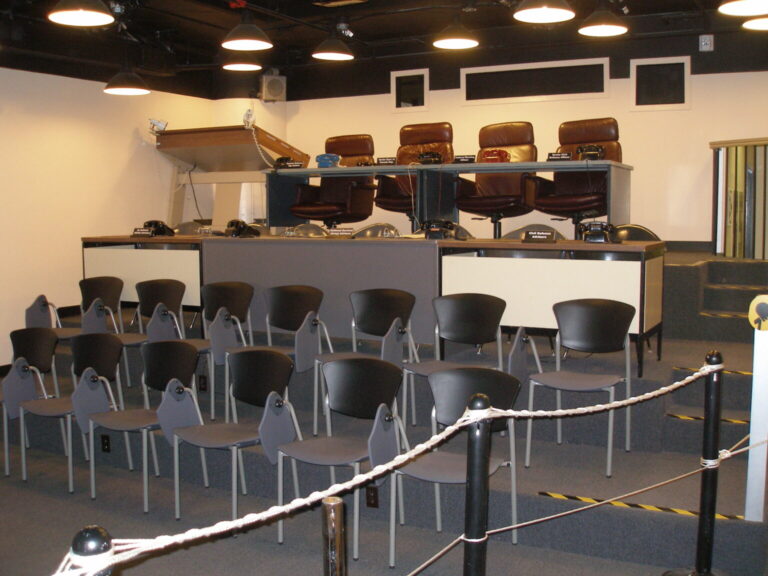
Almost Completed Replication of Original FWC Operations Theatre
The Federal Warning Centre (FWC) at the CEGHQ in CFS CARP (circa 1962-69)
The purpose of the FWC was to receive, collate and analyze graphical and narrative information provided by NORAD (North American Air Defence) command and control facilities (the Colorado Springs HQ in the US and the North Bay HQ in Canada) concerning a large scale nuclear attack on North America and to make and promulgate decisions related to sounding of the attack warning system sirens, evacuation and stay-put instructions, the issuance of fallout warnings and the provision of input to commitment of civil and military National Survival Resources decisions.
The Signals Room received the information either as telegram-type messages or in the form of punched tapes. The messages would have gone directly to the appropriate officials in the Display Room, while the punched tapes would have gone to the Plotting Room where they would have been transformed (by a special ‘etch-a-sketch’ type machine) into slides whereupon they would have been projected onto the Display Room screen for viewing by the Federal Warning Officer and supporting and officials and staff.
FWC Display Room
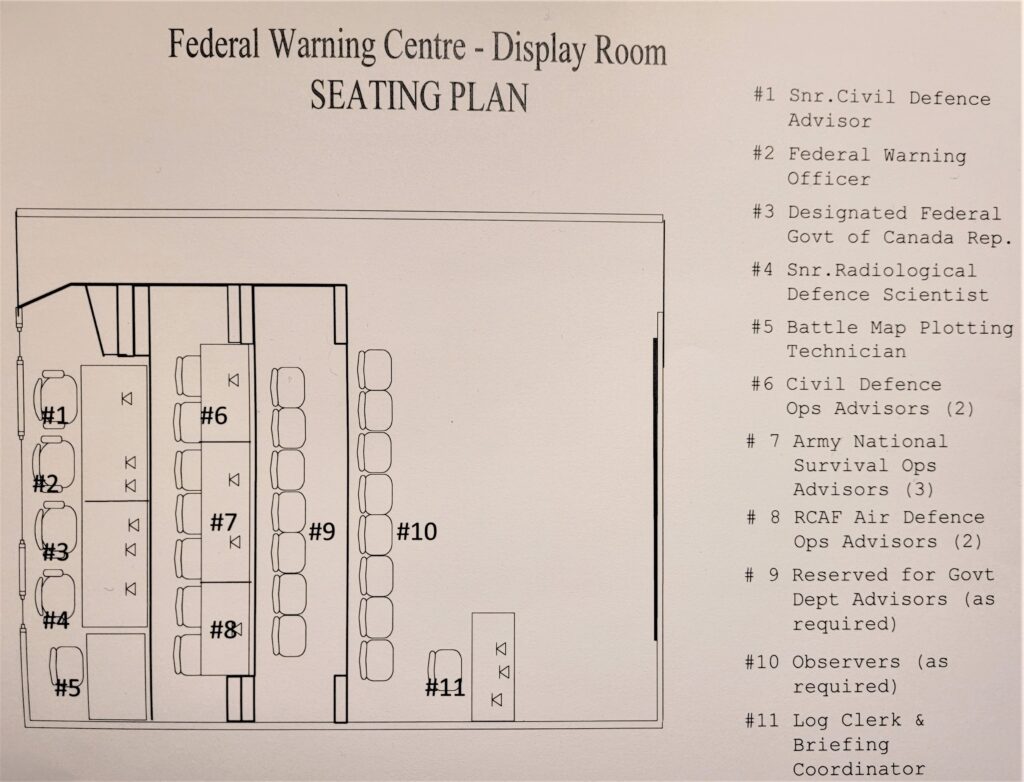
- On the top row of the theatre seating would have sat three or four fairly important individuals (the details of this are an informed deduction on my part-not much was formally written down of the subject of any standard operating officials that I have seen):
-The Federal Warning Officer (FWO), probably an Army Lieutenant Colonel (LCol). (During this period in the history of civil defence in Canada the government of Canada had given the responsibility for National Survival planning and operations to the Army because only they had the resources, command and control, and organisation to do the job). The FWO’s job would have been to decide when and where to sound the Attack Warning Sirens, when and where to order evacuations or issue stay-put instructions, when to activate the Emergency Broadcasting System, provision of initial information (such as NUDET and contamination areas) to Re-entry Columns, etc.
-The Head of Canada EMO (civil defence), a high ranking public servant (Director-General) whose job it would have been to advise and counsel the FWO on CD matters.
-A representative of Cabinet (Minister or designated Deputy Minister) to input to (and possibly override) decisions of the FWO. This person also would have kept Cabinet informed of evolving events and decisions.
-A VIP visitors ‘chair’ may also have been available on the top row for (for example the Chief Radiation Defence Officer, or a Senior Science Office ( or even maybe the PM or the GG!).
-Also adjacent to the top row (left) would have been a plotting table graphically recording the attack situation.
- The second row of the theatre seating was reserved for expert advisors, assessors and analysts.
- The third and forth rows were available for various observers, both military and civilian. It is likely that representatives from some of the federal departments and agencies along with officials from the Cabinet Secretariat and the Civil Defence Info Centre would have used these.
There was a table located to the left of the bottom row which was probably intended for a recording (log) clerk
FWC Plotting Room
- The punched tape or message form information provided by the FWC Signals Room would have been used to produce Iconorama images for projection onto the FWC Display Room screen.
- The plotting room would have kept an on-going record (drafting table to the right of the top row of officials) of the plotted information as updates occurred.
FWC Signals Room
- This information would have been received by the teletypes in the FWC Signals Room (via either the Emergency Radios Room or land line possibly through STRAD, probably but not necessarily encrypted).
- Copies and/or originals of all punched tapes/message forms would have been kept in the Signals Room.
- The room would also have disseminated warning information status and decisions to various locations including (and most importantly) the REGHQs/the provinces, and to our US CoG/NORAD and NATO partners.
- It may also have passed on such info directly to certain designated offsite federal departments and agencies,
The Federal Warning Centre (FWC) in the Central Emergency Government HQ – CEGHQ – (at the Carp ON ‘Diefenbunker) was an integral part of the cross-Canada nuclear attack warning system from its inception after the bunker’s construction was completed in 1961 to when it began to be decommissioned circa 1991. It was the central location from which the alerts resulting from detection of an enemy attack would have been disseminated nationwide, activating the network of attack warning sirens and CBC-based emergency radio broadcasts. It also could have provided after-attack information on fallout movements and advice on shelter in-place and evacuation orders as well as all-clear and safe-move information. (This later would have also been a matter of close coordination with the Regional Emergency Government HQs (REGHQs) in most of the provinces).
It performed some of the most important functions of the ‘Diefenbunker’s’ raison d’etre, by providing the centre for coordinated nation-wide sounding of the attack and fallout warning systems . More specifically the responsibilities of the FWC , especially in the 1960 and early 70s are listed below:
- Monitoring military intelligence and Iconorama postings of incoming Soviet bomber fleets and responding NORAD interceptors (relayed from NORAD HQs in Colorado Springs / Cheyenne Mountain Complex and North Bay Ontario),
- Using this info in making decisions about triggering all or some of the nationwide network of about 1700 Attack Warning System sirens,
- Using this info to activate the CBC Emergency Broadcasting System (and to input info to the messages to be broadcast on the EBS),
- Using this info to inform federal and provincial Civil Defence Officials (most later called Emergency Measures Officials),
- Briefing the War Cabinet/ Ministers, Operations Officials (EmGoSitCen and Departmental and Agency Officials) on on-going air defence battle situation,
- Advising the War Cabinet on the implications of declaring various levels of Alert and implementation of various measures contained in the War Book.
Note: The FWC would NOT have had any significant input to the fighting of the Air Defence battle and the computer-based SAGE system.
Estimated Fallout in Canada and RCAF Voodoo Aircraft Intercepting a Soviet ‘Bear’ Bomber
The FWC was originally located on the 300 level central to the War Cabinet room, the Emergency Government Situation Centre, the Cabinet Secretariat and various federal departmental offices (plus dedicated teletype and decoding rooms). Sometime between the late 1960s and the late 1970s the FWC was (rather inexplicably -its functionality would have been questionable in that location) relocated to the North Bay NORAD underground bunker). However in the early 80s it was moved back to its former location in the ‘bunker’ CEGHQ (see photo below).
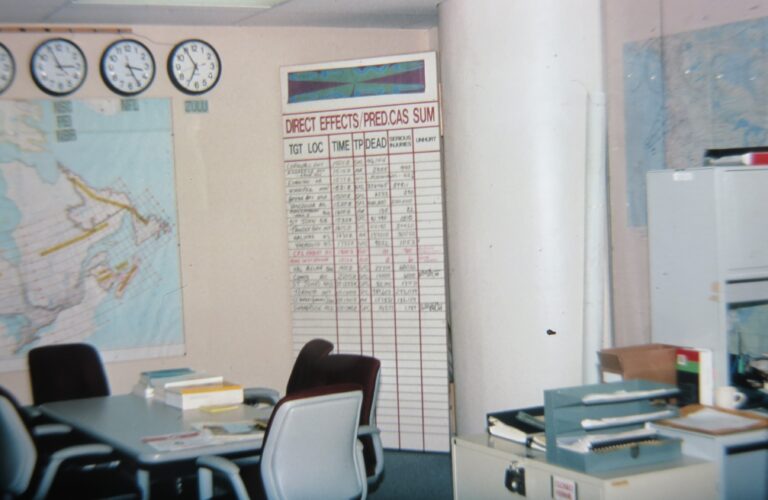
The FWC after it was moved back to the Carp facility in the early 1980s
Originally the FWC was a theatre-type ‘operations room’ with the North American air defence battle information projected from an Iconorama to front-mounted display screen. The room was full of various staff officers and technical advisors feeding information and advice from a wide variety of external and internal sources to the Federal Warning Officer- (in charge of the whole operation). By the time the FWC was moved back to Carp the theatre seating and all the projection related equipment had been removed and the configuration was simply that of a large open office (see above).
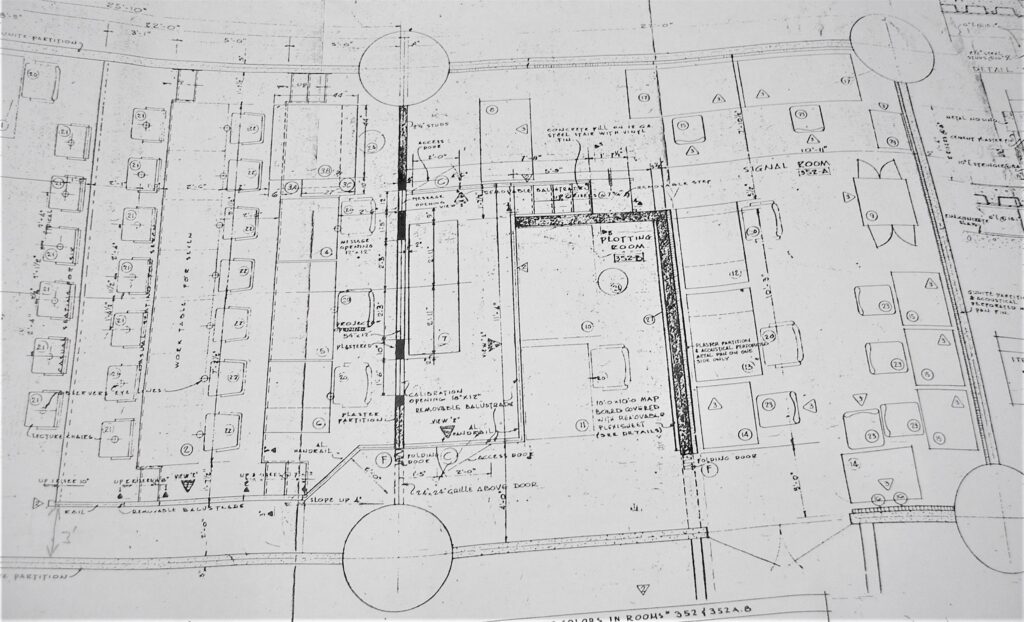
Original FWC Area Design Drawing (FWC left, Plotting (Decoding and Projection) Room centre, Teletype Room right)
In its original layout (above) it consisted of three rooms, the main Operations theatre, to the rear of which was the Plotting (decoding and projection) room and beside it the (rather noisy) Signals (telecommunications) room. (It was noisy because of the large number of teletype terminals crammed into the small room!)
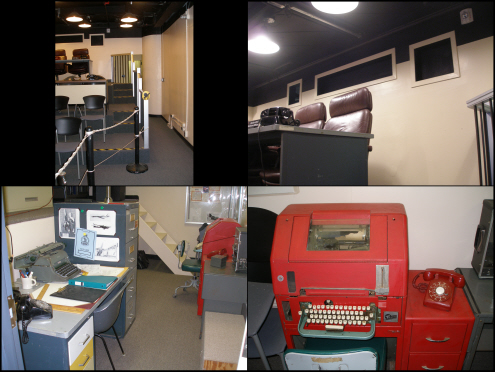
Corridor to Back of FWC Ops, Projection Windows on Backwall of FWC Ops Theatre, Decoding & Projection Office (the projection platform is to the upper left, Teletype for receiving Iconorama Image Information.
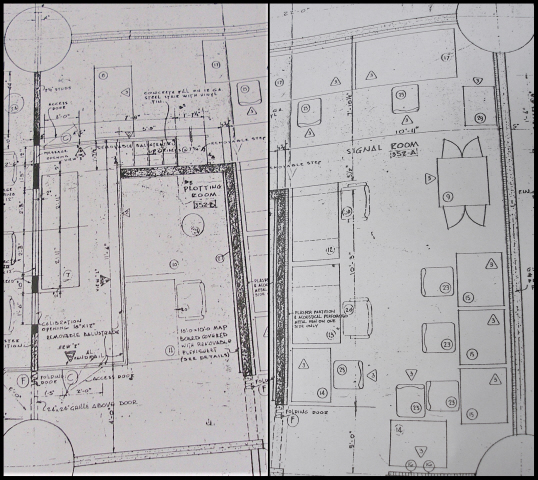
Original Layout of FWC Plotting Room for (decoding and Iconorama projection) and the Adjacent Signal (teletype) Room.
After the 1991 end of the Cold War and as the bunker was being transformed into Canada’s Cold War Museum, this open office area was initially used as space for an exhibit about the Strategic Threat to North America. When the original blueprints for the FWC area were ‘discovered’ (by volunteers Dave Peters and Dean McEwen in 2006) in the museum’s archives some years later it was decided to ‘reconstruct’ a slightly modified version of the original theatre style FWC.
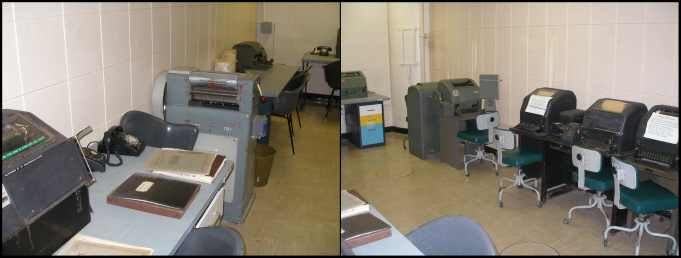
Reconstructed FWC Signals (teletype) Room
This took a number of years for volunteers to complete the reconstruction and by about 2010 most of the work had been done. To finish ‘dressing’ the Operations Display Room a series of appropriate operationally pertinent wall charts (see below) and situation status boards were intended to be installed. Regretfully in the transition from a management to a governance Board of Directors and the hiring of professional museum staff seemed to have resulted in this ‘dressing’ project not being considered to be a high enough priority to finance. While this part of the dressing plan was never completed. Unfortunately the projection capability for this display was removed some years ago. Fortunately the then new Executive Director did find and acquire some of the flip-top school desks that were in the front two rows of the room, emulating what had been in the original FWC.
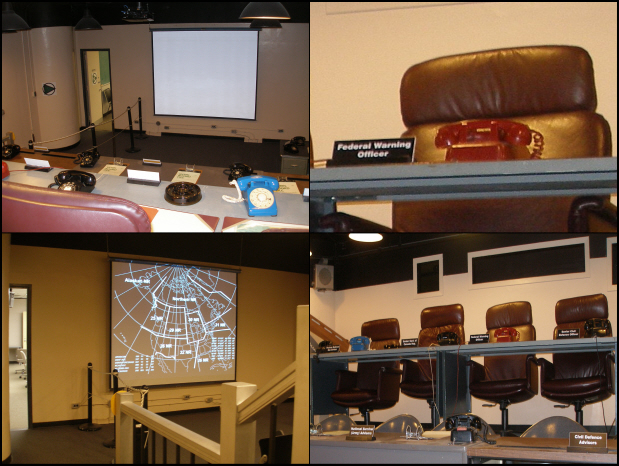
Air Battle Projection Screen, Senior Officials Seating, FW Officer and Red Phone
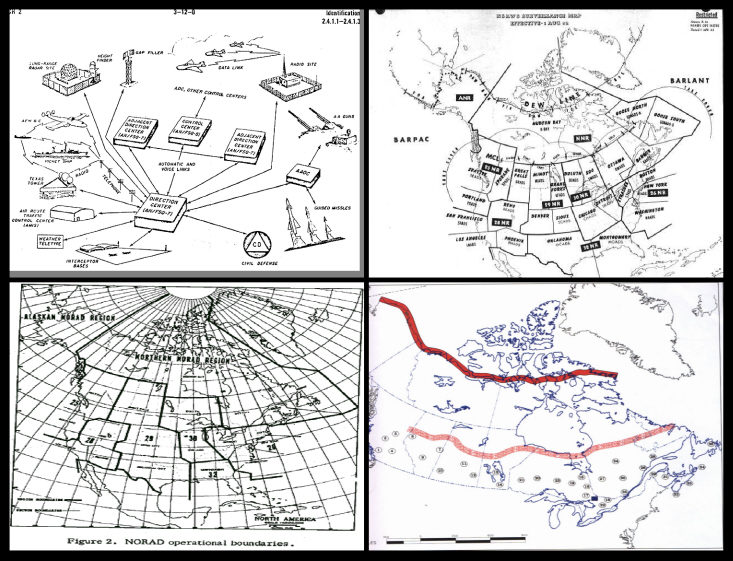
Some of the diagrams that typically would have been hung on the walls of the FWC Ops Theatre
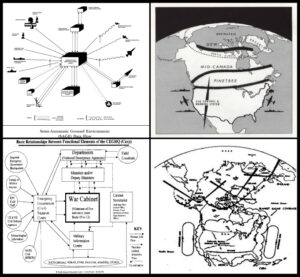
Some additional diagrams that typically would have been hung on the walls of the FWC Ops Theatre.