Originally BLOG #2 – 22 Jan 2020, from davescoldwarcanada.com.
Over the years since the creation of the Museum in 1997 there have been discussions, usually between volunteers about the subject of ‘hot bedding’ in the bunker. As often happens when such a seemingly simple question is posed, a simple answer given without context is not appropriate (besides having only thin educational value!).
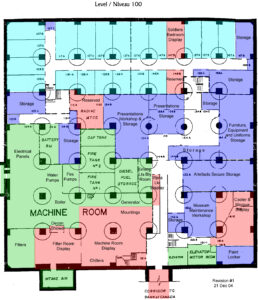
CEGHQ 100 Level Layout
First let me say that definitive procedures for activating, occupying and operating the Central Emergency Government HQ (the ‘bunker’) were sadly lacking when I took over the Emergency Government Facilities readiness responsibility in 1983. My predecessor in the Director, Emergency Operations Coordination (DEOC) position (the late Armand Wigglesworth) had done his best to be properly ‘ready’,given the complete absence of governmental/senior management support in the late 60s through the 70s. Many of the ‘Acco-fastener bound’ documents that we have in our archives were originally created by him, although I had more up-to-date versions and additional procedures written later on in the 80s. I was ‘lucky’ to have a boss who was interested and of course events resulting from the rising Soviet nuclear threat and its invasion of Afghanistan along with US President Regan’s rearmament/’Star Wars’ programs meant that I got significant support in rejuvenating the Continuity of Government Program during my tenure in EPC.
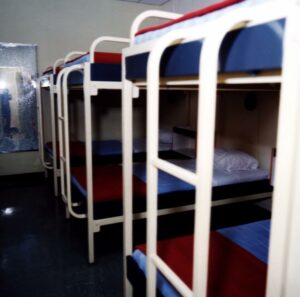
Typical Civilian Bedroom
Thus in 1984 an interdepartmental committee was formed (under my chairmanship) to ensure that at least the central facility could be made operational quickly if need be. This CEGHQ Activation Committee met every six to eight weeks and made significant progress in such preparations over the next six years until the Cold War ended and eliminated (at least for now) the need for such a program. We updated procedures, removed the military from the civilian areas of the facility, got some departments to seriously prepare their rooms, reactivated the Essential Record Program, renovated the EmGovSitCen, renewed our contacts with the equivalent US facility (Mt. Weather, VA), modernised the furniture and some of the equipment in the civilian areas of the facility, created an officials CoG briefing video (Just In Case), got the military to relocate the FWC back to Carp, and held two-day overnight exercises every December to practice operating procedures.
All of the above to say that from the outset in 1962 or so there was not a great deal written down in a doctrinal sense (at least that I could find). The best that we can do is refer to those of us that were around for different parts of the three decades of the bunker’s operational existence, complimented by research into what documentation we have in our archives and what we may be able to dig up from other sources such as DND’s Directorate of Heritage and History and the National Archives. I know we kept detailed minutes of the Activation Committee’s meetings. They are probably archived in government files somewhere where they will never see the light of day!
So here is what I recall about the usage of the bunker’s bed spaces:
I don’t know how many females would have been assigned to the bunker in the 60s but at that time there was an area – including washrooms – set aside (back part of the 300 level) for their use. Later, in the 1980s we did not bother to try to keep track of or make any particular bed spaces allowance for the gender of those assigned to bunker duties. Such issues would have been sorted out after lock-down as needed.
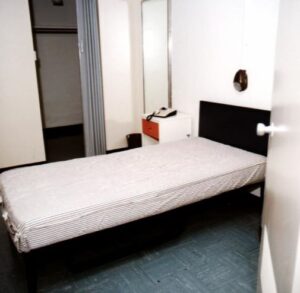
Original Bed Space in PM’s Suite “Diefenbunker” Museum
While the total number of bunker-assigned staff was initialyl (1960s) probably in the 400s, during my time the bunks in the anti-rooms of the bed rooms were counted on for use in the total numbers of bed spaces needed to accommodate about 535 souls that then (80s)would have been assigned to duties in the bunker. Remember that most of the non-senior officer military positions at the bunker were to be accommodated on a hot-bed basis. This would have included female members of the forces as well. None (or very few anyway) of the male or female civilian occupants of the bunker were expected to hot-bed. With the passage of the Emergency Preparedness Act in the late 80s this would have had to eventually change. That was because the 1988 Act called for protection of ‘constitutional’ government.
Prior to that time protective arrangements referred to government, not ‘constitutional’ government. The former can be dealt with by the ‘executive’ (War Cabinet working with the Governor General). The latter requires having a quorum of both the H of C and the Senate and the Supreme and Federal Courts. After consulting with constitutional legal experts it was decided that having 60 to 100 more (than the 535) bed spaces would do it. We were in the process of triple bunking many of the double-bunked bedrooms to meet these increased needs when the Cold War suddenly ended.
The number of Cabinet Ministers that would have been at the bunker varied but we counted on between 13 and 18, to cover the following: Agriculture; Finance; Public Works; Communications; Employment and Immigration; Energy, Mines & Resources; Environment; External Affairs; Fisheries & Oceans; Industry, Trade & Commerce; Labour; Health & Welfare; Post Office; Solicitor General; Transport Canada; Supply & Services; Justice; National Defence; Emergency Preparedness; CMHC.
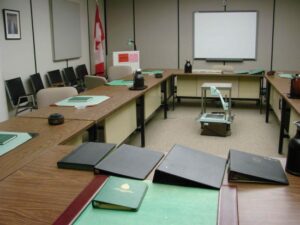
War Cabinet Room
The absolute minimum we needed was four. Those, in addition to the GG, were sufficient to form the Governor-in-Council , and executive body and to pass regulations by decree – prior to the ‘constitutional issue that I mentioned above changing things. They would have had priority use of the individual bed rooms on the 200 level, but there would have very likely been sufficient single rooms for the ED of the CBC/Radio Canada, the Commissioners of the RCMP and the Coast Guard and like positions.
In my time (1980s and early 90s) the Communications Security Establishment (CSE) appeared to be the driving force/largest user of the OSAX. There was a close relationship between the bunker staff and CSE. There was a metal plaque that they donated to the museum in the late 1990s. It should be in the museum’s collection somewhere. I don’t know whether or not the CO was permitted entry to OSAX. I somehow think he was since it was his personnel that operated it. I was not allowed entry as I had no ‘need to know’, a key component in all security clearance procedures.