Known as the “Key” (1st Key, 2nd Key, 3rd Key, etc.) series of exercises
These exercises were two to three day events held annually (mid Dec 1984-1989) in the CEGHQ, CFS CARP, Ontario. They involved between 40 and 60 federal government departmental officials (usually those whose regular responsibilities included emergency planning and/or response duties).
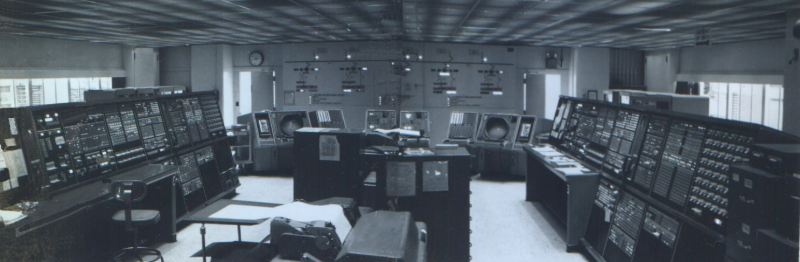 The object of the exercise was two-fold: Firstly, to familiarise officials with the CFS Carp facility and the duties they would have performed in it if deployed there during a potential nuclear war crisis and secondly, to practice the mechanics of collecting, analysing and reporting/briefing information received from external and internal sources while under stress conditions.
The exercise was conducted in as realistic a manner as possible by means of the following:
a) The facility was locked down for the duration of the exercise,
b) The officials slept in their assigned rooms, worked in their assigned offices and ate in the cafeteria (including one or two meals of hard rations),
c) Inputs came (in the form of teletype messages) from NORAD, and DND briefings from the Military Information Centre/Federal Warning Centre,
d) The public address system was used to create a realistic (and deliberately distracting) background information noise,
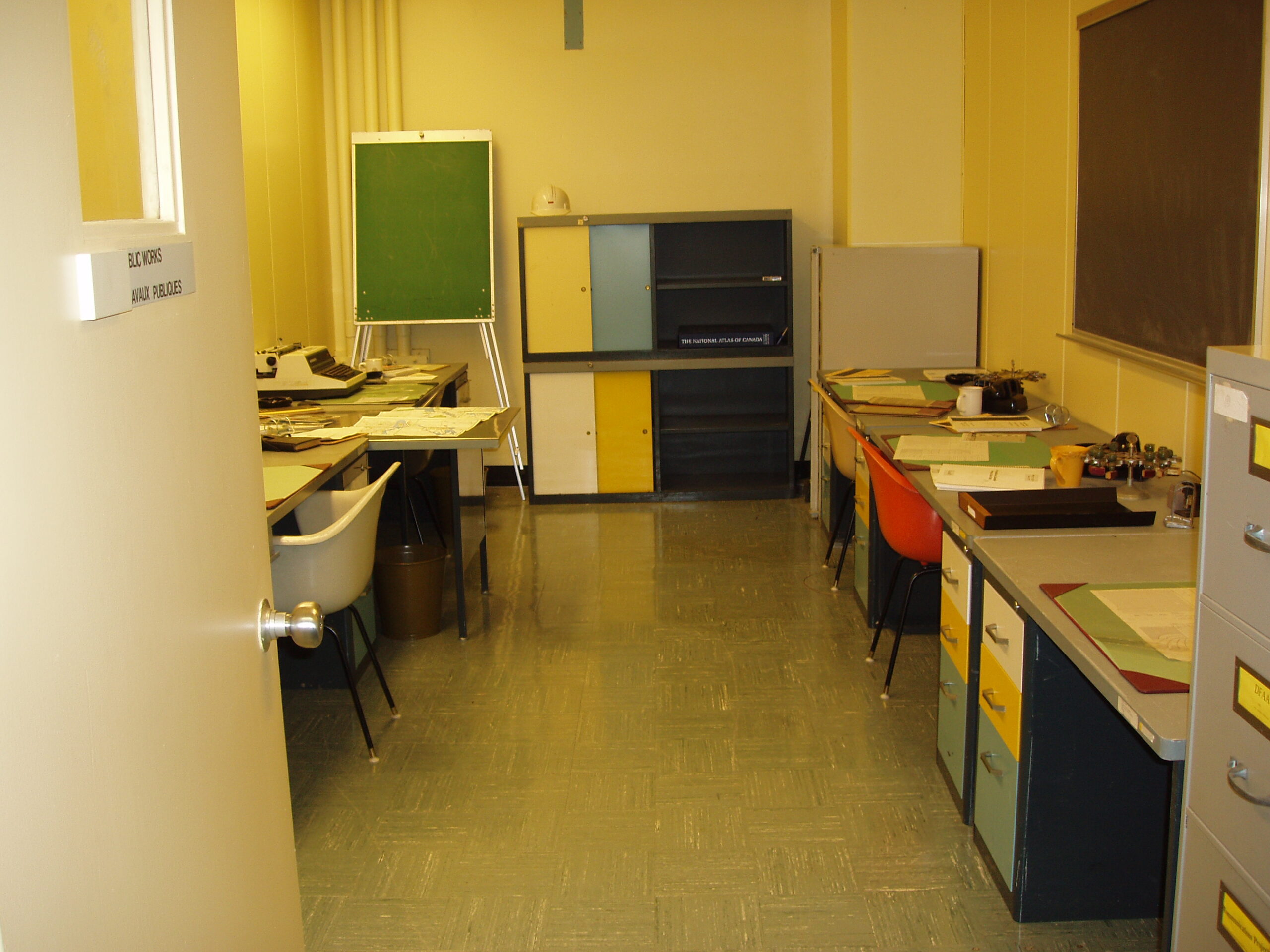
Typical Departmental Office for six officials (would have supported 12 in 24&7 Operations). Original Steelcase furniture 1961 to renovations in mid 80s.
e) Briefing of departments and the War Cabinet were frequent time/deadline driven and required constant revision/updating,
f) The shifts were 12 hours long plus 1/2 hour handover briefing, meals had to be taken when the flow of activity permitted,
g) Staff was borrowed from the Emergency Preparedness Training College at Arnprior to do the technical attack fallout and casualty and damage analysis of the nuclear strikes sent to us by NORAD HQ at the Cheyenne Mountain facility,
h) Random (dummy) events involving the security and environmental support systems of the bunker were sometimes inserted to add interest (and as a further source of distraction/interest).
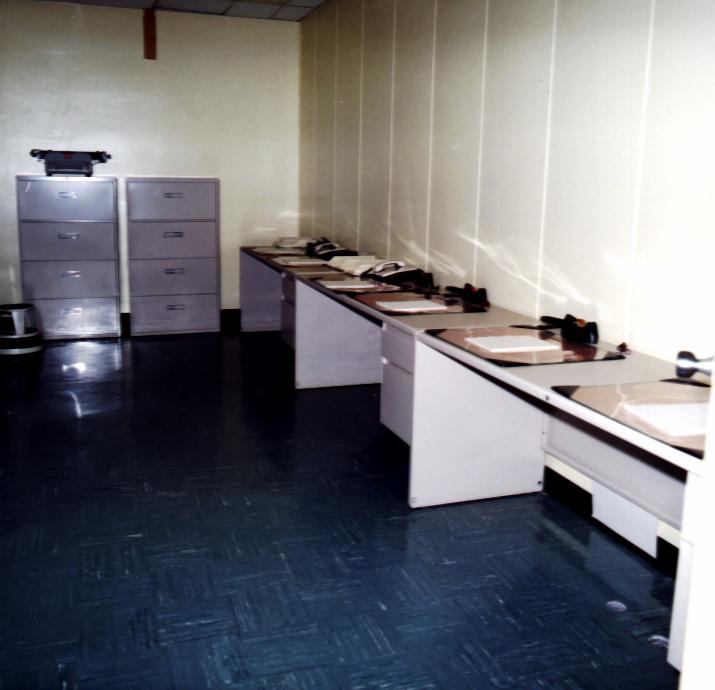
Post mid-life refit (circa 1986) Departmental Office with new Steelcase furniture
i) While the feed-in events (including NUDETS) were pre-scripted, the responses were not and subsequent free-play was encouraged.
Because we were never fully staffed with the full complement of officials that would have been present for an actual full activation of the CEGHQ , the whole exercise had to be simplified somewhat to enable it to work at all.
The primary centres of play we used had to combine various functions so we organised them as follows (trying to follow the actual organisations as closely as possible).
- Those being exercised namely the EmGovSitCen and participating Departments/Agencies.
- Lower Control – Those providing inputs consisting of the Federal Warning Centre/the Military Information Centre, the Meteorological office, NORAD (and DND), the Emergency Preparedness Canada office (representing Regional HQs, etc.).
- Higher Control – The War Cabinet / and supporting Cabinet Secretariat (where all briefings were aimed at and from where queries would emanate – to be responded to quickly and as concisely and accurately as possible).
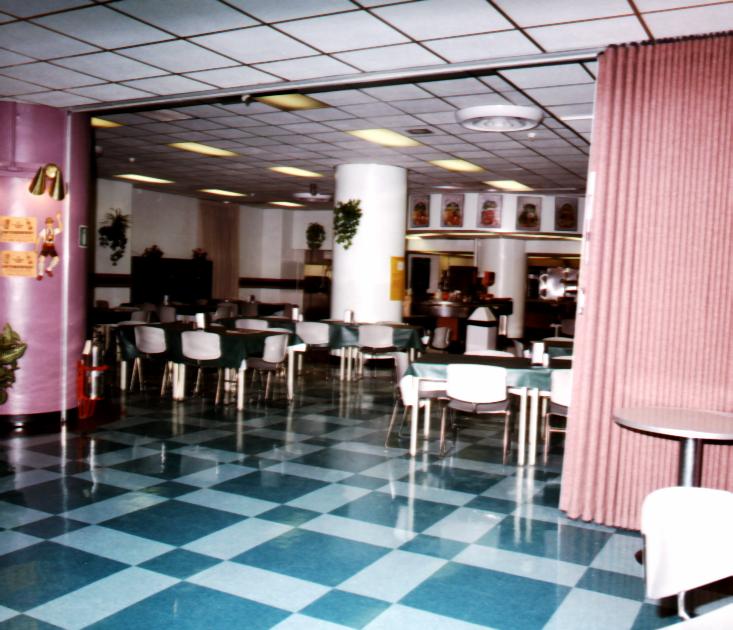
Diefenbunker Cafeteria (late 1990s)