 Introduction:
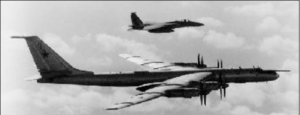
The Tupolev Tu-95 (NATO code-named BEAR) was one of the iconic aircraft of the Cold War.
Pictures of the Bear frequently graced the pages of Western magazines and newspapers, usually with a NATO jet interceptor in close company, as it patrolled the fringes of NATO airspace.
 Development:
Early in the 1950’s the Soviet government issued a new requirement to both the Tupolev and Myasishchev design bureaus for a bomber that would have an un-refueled range of 8000 km (4,970 mi) — far enough to threaten key targets in the United States. Other goals included the ability to carry an 11,000 kg (11 ton) load over the target.
Tupolev’s proposal was selected and Tu-95 development was officially approved by the government on July 11, 1951.
The Tu-95/I first flew November 11, 1952 but suffered a propeller gearbox failure and crashed. However, after a further, successful flight testing phase, series production of the Tu-95 started in January 1956.
 Operations:
Like its American counterpart, the Boeing B-52 Stratofortress, the Tu-95 has continued to operate in the Russian Air Force while several subsequent iterations of bomber design have come and gone. Part of the reason for this longevity is its suitability, like the B-52, for modification to different missions. Whereas the Tu-95 was originally intended to drop free- falling nuclear weapons, it was subsequently modified to perform a wide range of roles, such as the deployment of cruise missiles, maritime patrol (Tu-142), and even civilian airliner (Tu-114). An Airborne Early Warning (AWACS) variant (Tu-126) was developed from the Tu-114.
The Tu-95RT variant in particular became an icon of the Cold War as it performed a vital maritime surveillance and targeting mission for other aircraft, surface ships and submarines. It was identifiable by a large bulge under the fuselage, which housed a radar antenna that was used to search for and target surface ships.
During interceptions by NATO fighters, Tu-95 tail gunners typically kept their twin cannon pointed upwards so as not to antagonize the intercepting fighters. Similarly, NATO rules of engagement for interceptions restricted aircrews from locking onto the Tu-95 with fire control radar lest this be misinterpreted as a hostile act.
During the height of the Cold War, the long range of the aircraft was demonstrated weekly as a pair of Tu-95s would fly from the Kola Peninsula to Cuba along the East Coast of the United States, escorted continuously along the way.
The Tu-95 carried and dropped the AN602 Tsar Bomba, the largest and most powerful nuclear weapon ever detonated (deliberately de-rated from 100 to 50 megatons), in 1961.
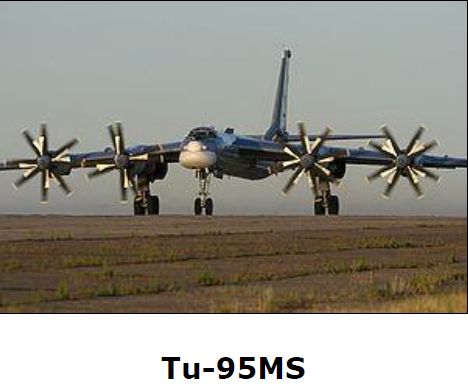
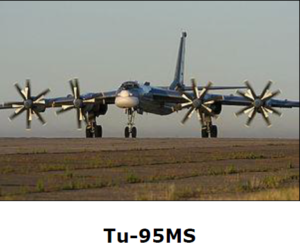
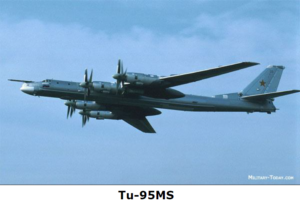
All Tu-95s now in Russian service are the Tu-95MS variant, built in the 1980s and 1990s. The Tu-95 is expected to remain in service until 2040.1
1 This would be an extraordinary achievement, almost 90 years of service for this aircraft!
Variants:
The following are some of the principal variants of the Tu-95.
- Tu-95/Tu-95M: Basic variant of the long-range strategic bomber. Known to NATO as the Bear-A.
- Tu-95K/Tu-95KD: Designed to carry the Raduga Kh-20 air-to-surface missile. Known to NATO as the Bear-B.
- Tu-95MR: Bear A modified for photo-reconnaissance and produced for Naval Aviation. Known to NATO as the Bear-E.
- Tu-95MS/Tu-95MS6/Tu-95MS16:– Completely new cruise missile carrier platform. This variant became the launch platform of the Raduga Kh-55 cruise missile. Known to NATO as the Bear-H.
- Tu-114: Airliner derivative of Tu-95.
- Tu-95LaL (Tu-119): Experimental nuclear-powered aircraft project.
- Tu-126: AEW&C derivative of Tu-114.
- Tu-142: Maritime reconnaissance/anti-submarine warfare derivative of Tu-95. Known to NATO as the Bear-F.
Specifications
General characteristics
- Crew: 6–7
- Length: 46.2 m (151 ft 6 in)
- Wingspan: 50.10 m (164 ft 5 in)
- Height: 12.12 m (39 ft 9 in)
- Wing area: 310 m² (3,330 ft²)
- Empty weight: 90,000 kg (198,000 lb)
- Loaded weight: 171,000 kg (376,200 lb)
- Max takeoff weight: 188,000 kg (414,500 lb)
- Power plant: 4 × Kuznetsov NK-12M turboprops, 11,000 kW (14,800 shp) each
Performance
- Maximum speed: 920 km/h (510 knots, 575 mph)
- Range: 15,000 km (8,100 nmi, 9,400 mi) unrefueled
- Service ceiling: 13,716 m (45,000 ft)
- Rate of climb: 10 m/s (2,000 ft/min)
- Wing loading: 606 kg/m² (124 lb/ft²)
- Power/mass: 235 W/kg (0.143 hp/lb)
Armament
- Radar-controlled Guns: 1 or 2 × 23 mm AM-23 auto-cannon in tail turret.
- Missiles: Up to 15,000 kg (33,000 lb), including the Raduga Kh-20, Kh- 22, Kh-26, and Kh-55 air-to-surface missiles
References:
-
-
Soviet Military Power, 1990, US Defence Department
- http://en.wikipedia.org/wiki/Tupolev_Tu-95
- http://www.ausairpower.net/Profile-Tupolev-Bear.html
- http://www.fas.org/nuke/guide/russia/bomber/tu-95.htm
- http://www.centennialofflight.gov/essay/Aerospace/Tupulov/Aero59.htm
- http://www.military-today.com/aircraft/tupolev_tu95_bear.htm
-
 Captain (N) (Ret’d) M. Braham, CD – Mike Braham is a graduate of the Royal Military College (1965) and a former naval officer and senior official with DND. He has an abiding interest in military history.