
Ottawa Cold War Places to “Visit” #5
The Diefenbunker, Canada’s Cold War Museum (formerly the Central Emergency Government Headquarters the CEGHQ – at the former Canadian Forces Station Carp, Carp, Ontario
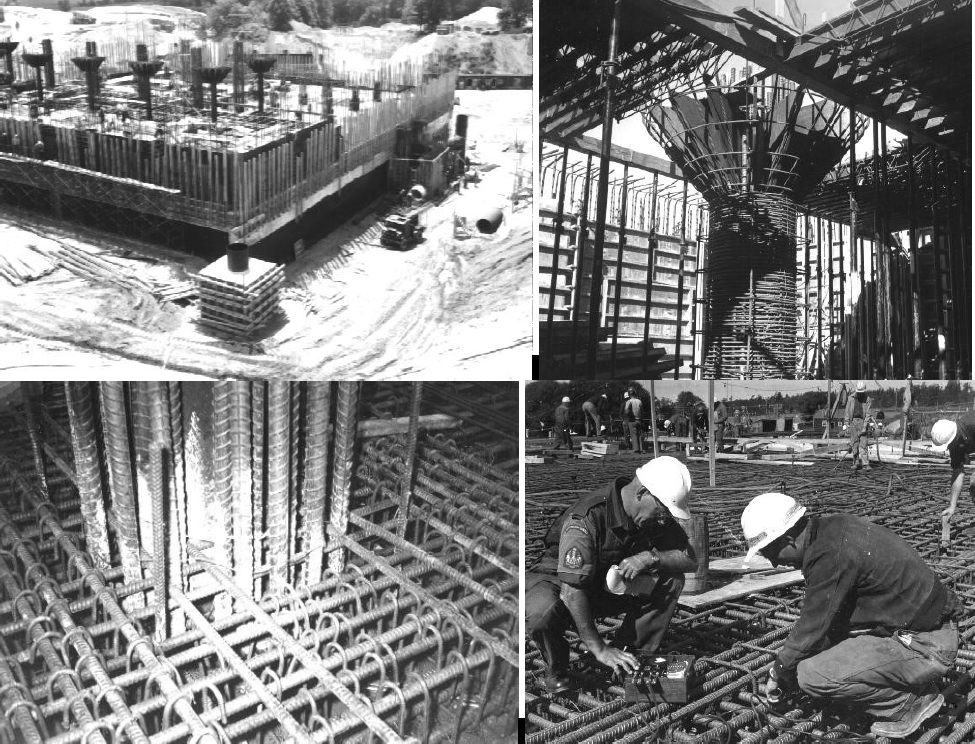
Construction photos of the “Diefenbunker” – Click to enlarge
- The Building “In-Brief”
- Constructed 1959 to 1961
- On time, on budget using Critical Path Method of Project Management (although certain capabilities- primarily concerned with telecommunications equipment – were not yet satisfactorily operational as late as 1963).
- Four floors total just over 100,000 square feet of useable space (+ Bank of Canada Vault + “Garage”)
- Built under supervision of Department of National Defence Military Engineers and Signal Staffs by Foundation Company of Canada (Montreal)
- Cost approximately $20 million for structures (about $110 million in today’s dollars)
- Monolithic structure designed to resist a nuclear detonation by displacing a few inches in a five foot thick envelope of gravel
- About 154 ft x 154 ft square, 60 ft “tall” box
- 5000 tons of reinforcing steel
- 33,000 tons of concrete
- Top and bottom slabs each about five feet thick
- 36 columns each about 4.5 ft in diameter (and each capable of supporting 6900 tons)
- Design overpressure of 100 psi would have put about 3500 tons force on each column
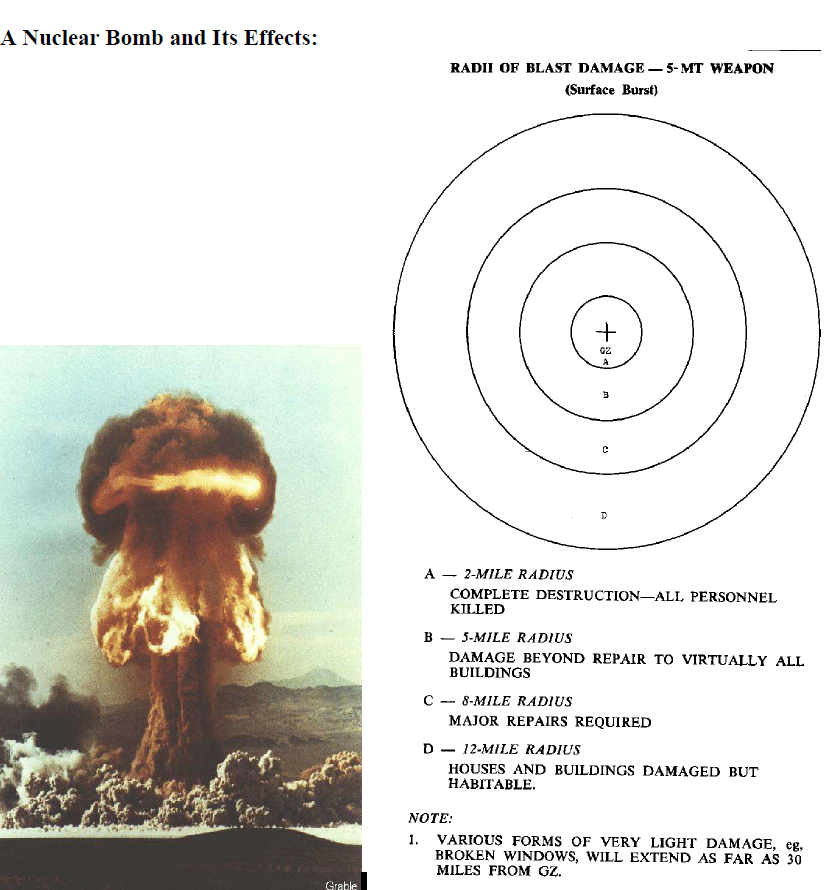
A Nuclear Bomb (early multi-megaton-yield design) and Its Effects – Click to enlarge
Background / Origins
An Interdepartmental Working Group on War Measures was created (by the Federal Government) in 1956 to deal with rising concerns about a potential nuclear attack. The threat at that time was primarily concerned with manned bombers originating in the Soviet Union, carrying large yield nuclear weapons targeted against military installations, economic/industrial infrastructure and population centres. In January of 1957 the Committee recommended the establishment of emergency government headquarters at the federal, provincial (regional), and local (sector) levels,. Specifically it stated:
“If provision is not made in peacetime for emergency re location sites, these governments may be unable to function when war starts. There will be no time then to improvise the necessary facilities outside the present capitals. It is therefore recommended that steps should be taken now to develop an emergency government organization comprising a federal emergency headquarters in the vicinity of Ottawa, a regional emergency headquarters in each province that would include both a federal and provincial component as well as an army component, and possibly a number of sector headquarters in each province. The various headquarters would be interconnected by an integrated, government communications network so designed as to permit the exercise of either decentralized or centralized control.”
Planning for the maintenance of government authority, which was reviewed by the committee, included consideration of communications, law and order, legal problems, essential records, as well as emergency government facilities. Thus the Continuity of Government Program was conceived in the late 50s in an attempt to provide for a “thin thread” of continuous government in the event of a nuclear attack on North America. In August of 1958 Prime Minister Diefenbaker, announced the Program to the Parliament of Canada.
The Canadian Army also became heavily involved in the area of continuity of government by its acceptance of responsibility for constructing the central and regional emergency government headquarters and providing communications equipment.
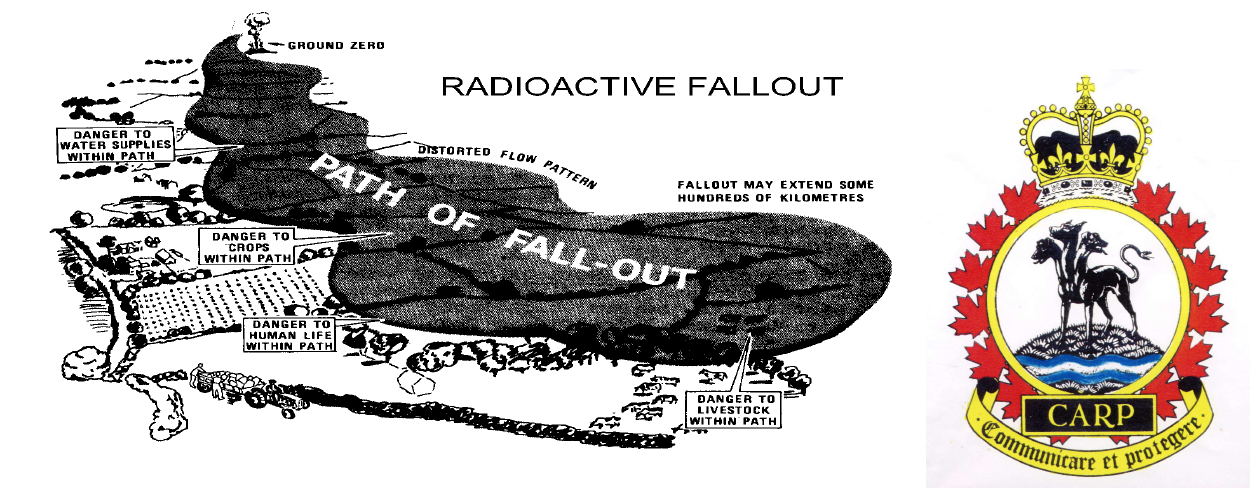
Typical fallout path (of an early bomb’s ground-burst) and the CFS Carp crest – Click to enlarge
Military Role
The Department of National Defence also used this system of protected buildings on a full time basis as the backbone of its strategic telecommunications system. The Carp facility and it various other structures elsewhere on the Ottawa valley, were part of Canadian Forces Station (CFS) Carp. On CFS Carp’s official crest was the three headed dog, cerberus, the mythical guardian of the gates to Hell. They were also responsible for running the Federal Warning Centre, for calculating and plotting the effects of an attack on the people and infrastructure of the country, and for administering the operations and maintenance (on a landlord basis) of the facility.
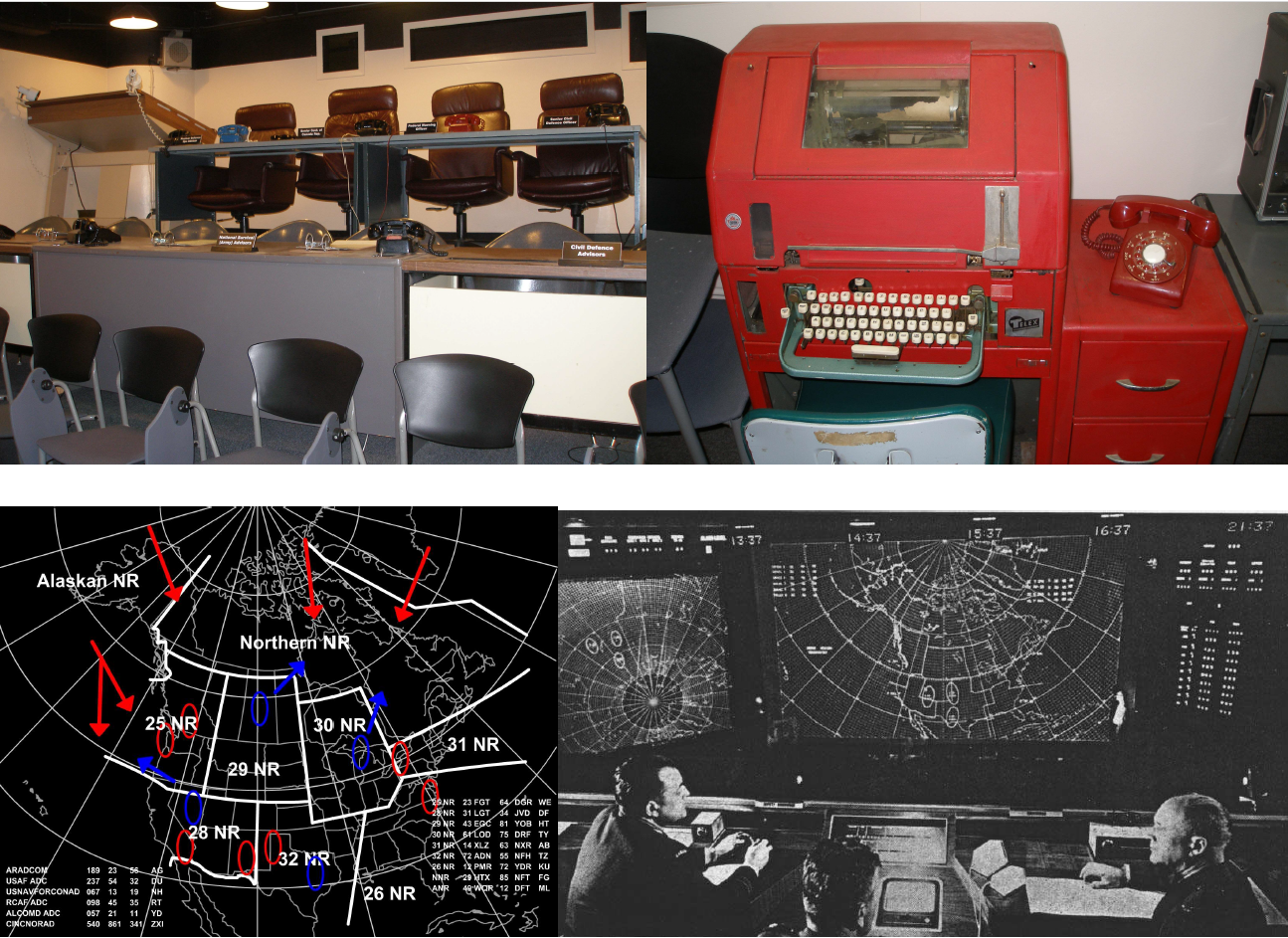
Federal Warning Centre equipment & displays – Click to enlarge
The FWC would have been responsible for deciding when and where to sound the Attack Warning Sirens, when and where to order evacuations or issue stay-put instructions, when to activate the Emergency Broadcasting System, provision of initial information (such as NUDET and contamination areas) to Re-entry Columns, etc.
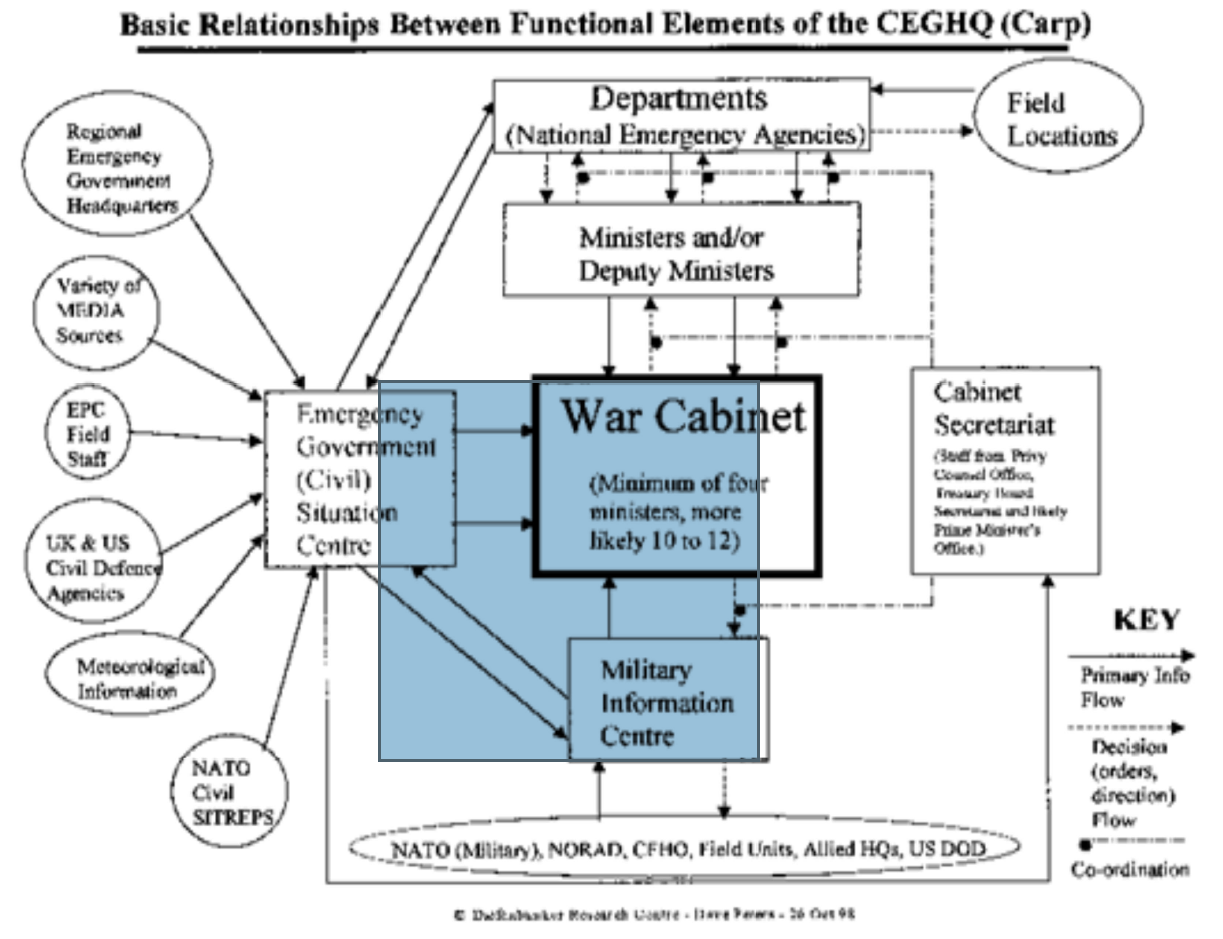
Basic relationships between Functional Elements of the CEGHQ (Carp) – Click to enlarge
The Role of the “Diefenbunker” (The Central Emergency Government Headquarters) in Canada’s Civil Defence/Continuity of Government Program
Background
1. Constructed in the years 1959-61, the Central Emergency Government Headquarters (CEGHQ) at Canadian Forces Station Carp, popularly known as the Diefenbunker, was the flagship of a hierarchy of a cross-country network of government shelters which were an integral part of Canada’s preparations for a possible nuclear attack on North America. Militarily Canada hoped to gain some protection through participation in such collective defence alliances as the North American Air Defence (NORAD) Agreement and the North Atlantic Treaty Organization (NATO).
2. On the civil side a rudimentary Civil Defence program was in existence although it never really fully reached a state of complete readiness. Arrangements were at varying degrees of preparedness in the following areas:
a) The Continuity of Government Program (the system of shelters for selected government officials),
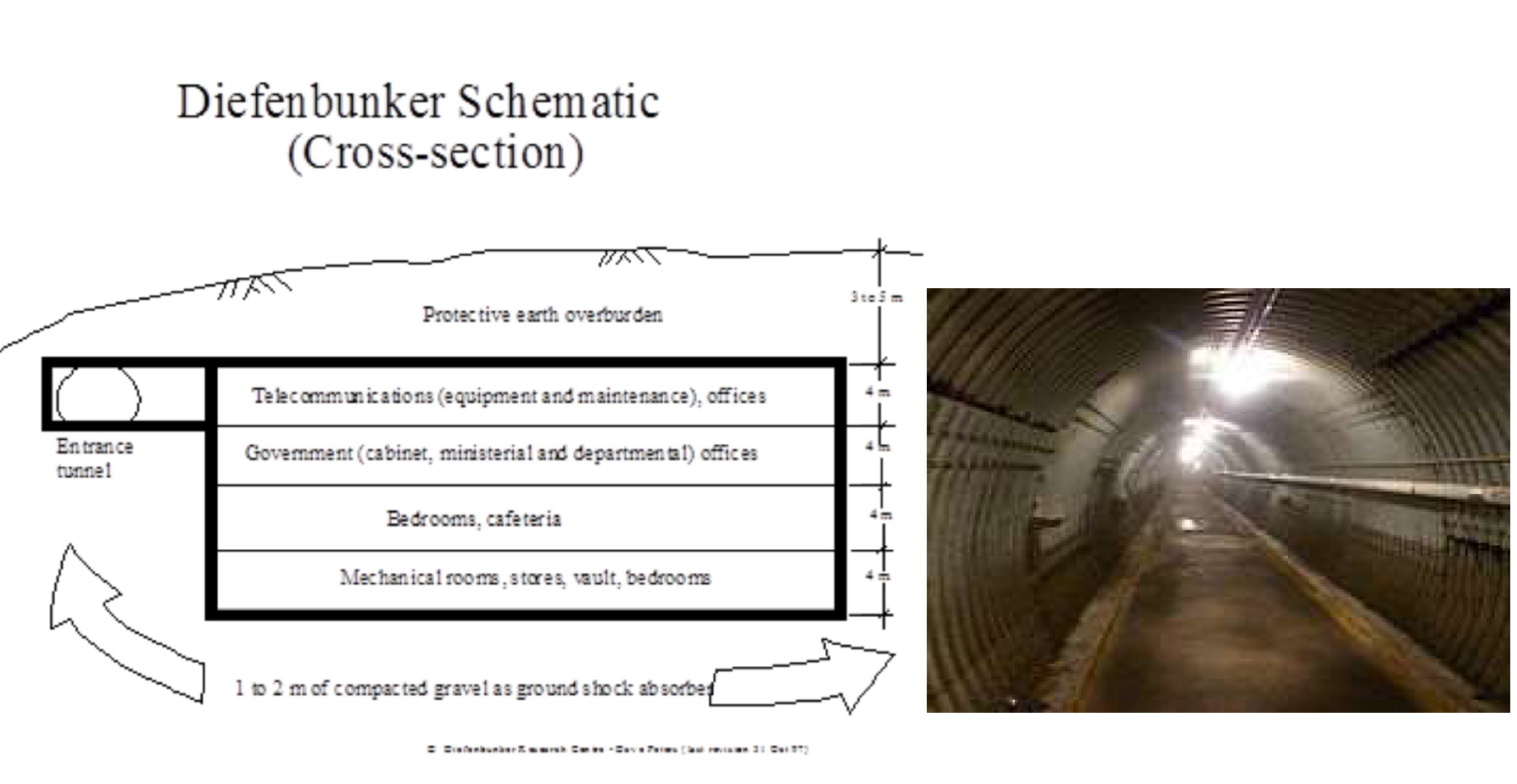
Diefenbunker schematic (Cross-Section) and tunnel photo – Click to enlarge
b) Public and private fallout shelter programs,
Civilian radiation detector types and a home fallout shelter design – click to enlarge
c) Radiation Defence (monitoring and reporting on nuclear detonations and fallout radiation levels),
d) The Emergency Broadcasting System (mainly CBC radio),
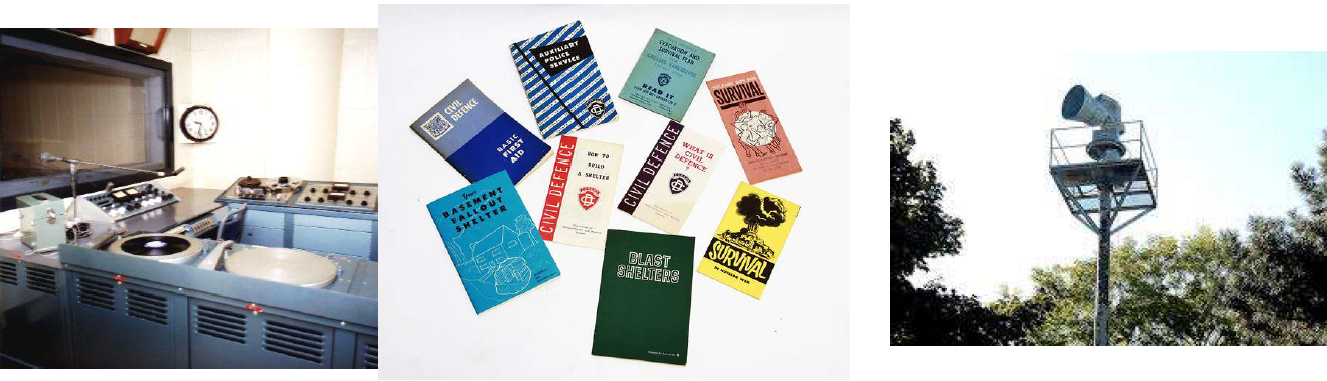
CBC studio in the bunker, CD pamphlets, and a warning siren – click to enlarge
e) The Emergency Public Information System ( government run, to be staffed by public relations specialists and well-known media personalities),
f) Emergency Hospitals and Medical Treatment Arrangements ( 200 stored deployable 200 bed hospitals along with thousands of prepackaged kits for other medical treatment including blood
transfusions, etc.),
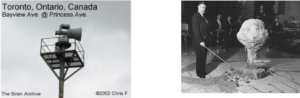
An air raid siren from Toronto and a Civil Defence lecture – click to enlarge
g) The Attack Warning System ( a system for triggering the nation-wide system of 1700 sirens and pre-recorded emergency radio broadcasts),
h) Re-entry (into damaged areas) and rescue (from collapsed structures) arrangements (in the early 60’s the responsibility of the Army but later given to the provinces).
Continuity of Government (C of G) Facilities
3. Primary control of all of the above programs would have emanated from the CEGHQ at Carp where about 550 people would have been involved in the information acquisition and analysis, decision making and telecommunications operations necessary to attempt to provide for a “thin thread” of continuity of government from before to after a nuclear attack. By this means it was hoped to avoid having the whole country falling into complete anarchy. Of course this would not have been done in complete isolation.
Sufficient redundant telecommunications existed to provide contact with areas of the country not so badly hit by fallout and with other headquarters in the network.
4. In the provinces, at a safe distance from their capital cities, were Regional Emergency Government Headquarters (REGHQs) sheltering upwards of 350 people including representatives of provincial governments. A few REGHQs had Regional Relocation Units (RRUs) for overflow and backup purposes. In provinces with large populations there were additional Zone Emergency Government Headquarters (ZEGHQs) that reported to REGHQs and to which Municipal Emergency Government Headquarters (MEGHQs) would have reported.
The Governor-in-Council and Backup
5. As a backup to the CEGHQ there were six other less protected shelters located at further distances from Ottawa in equipped spaces in the basements of various federal buildings from Cornwall to Pembroke. These Central Relocation Units (CRUs), similar in some respects to the RRUs mentioned above, held 90-150 people and could have taken over in case the Carp bunker was destroyed or otherwise out of operation. Sufficient officials, legally empowered to act on behalf of the government were located in the CRUs in order to act as the Governor-in-Council if necessary.
6. To have legal government in Canada in such an extreme emergency (as a nuclear attack on North America would have been), all that was needed was the Governor-in-Council (G in C) consisting of a group of four ministers (one of which would likely have been the Prime Minister) and the Governor General. If the GG was dead or unable to function, The Chief Justice of the Supreme Court (or failing that), any justice of that court would have sufficed. These ‘teams’ of ministers and justices would have been located in the CRUs, ready to assume their role as backup if necessary.
CEGHQ Organization
7. The Governor-in-Council along with other ministers of the War Cabinet would have been the core officials in the bunker. A small Cabinet Secretariat (composed of officials from the Privy Council Office) would have provided coordination of government operations. They and other decision makers would have been further supported by about 300 officials representing some 20 federal departments and agencies responsible for such functions as national defence, food production and distribution, transportation, communication, public works, housing, security, and many others. A small Military Information Centre would have kept everybody informed as to the military situation in North America, Europe, and the World. Likewise a small Civil Information Centre would have kept officials up-to-date on what was happening in Canada with respect to damage and casualties to the population and the impact of the attack on the nation’s infrastructure (bridges, rail centres, ports, grain and other food supplies, telecommunication systems, energy supplies, and the like). Military personnel would have provided both the telecommunications into and out of the CEGHQ as well as the site administration (feeding, facility maintenance and operation, security, etc.) services.
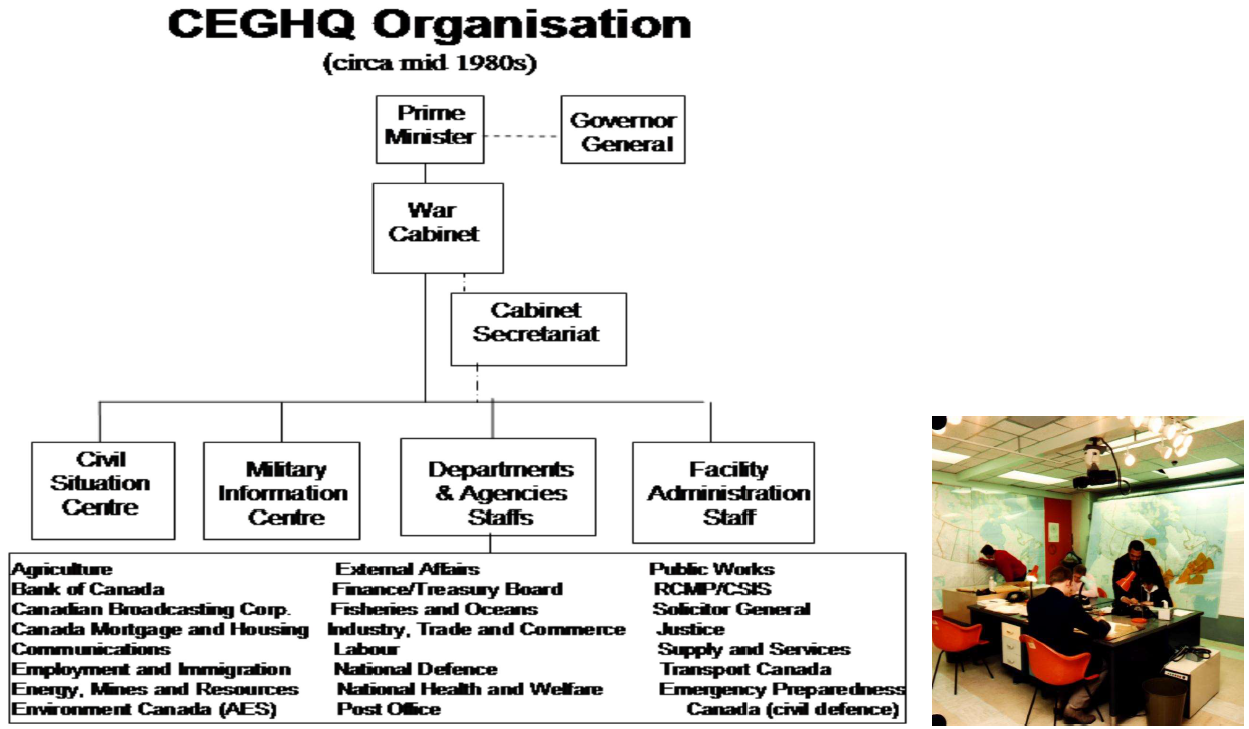
CEGHQ Organisation (circa mid 1980s) – click to enlarge
Some General Comments
8. Backup and alternatives were to be arranged for every person who would have been assigned a responsibility at the CEGHQ to ensure that all positions would have been filled upon the close down and full occupation of the facility. Movement of people, records, equipment and supplies would not have been a last minute rush because advance parties would have moved onto location when strategic warning of a possible threat of attack was received, possibly weeks earlier. Higher level selected and elected officials would have moved to the bunker using the fastest means possible on receipt of tactical warning. At that time an attack would have imminent and the take-cover warning sirens would likely have been sounding across the nation. As an interesting side note no occupant of any of the various emergency government headquarters would have been permitted to bring his or her family to the shelters – they had to make their own family protection arrangements.
Conclusion
9. The Diefenbunker (CEGHQ) at Carp was at the centre of a large network of shelter facilities, plans, arrangements, and other organizations that would have attempted to provide for a level of continuity-of-government during and immediately after a nuclear attack on North America. To what degree it would have successfully done so was, fortunately, never tested and will never be known. From time-to-time the cold war heated up but it never really hit the boiling point and turned into an all out exchange of nuclear weapons.
The Museum
Civil emergency preparedness officials ceased their responsibilities in the bunker in the fall of 1992 and the DND decommissioned the Carp site in December of 1994. The original plan seems to have been to strip the building of anything useful and then seal it.
Fortunately officials of West Carleton Township, urged on by a group of strong-minded volunteers took a wider vision of the potential of the site. The township acquired the site and all of its structures (along with some environmental cleanup obligations) for under $300,000. Unfortunately by the time the paperwork was done, most of the interior furniture and equipment had been removed by DND and sent to the dump or Crown assets for disposal.
In June of 1998 negotiations with the Township were completed and the approximately 14 acres inside the inner perimeter fence and 4 acres adjoining the road were acquired by the nascent Cold War Museum for $3. On June 27th the Historic Sites and Monuments Board of Canada unveils an official plaque in a ceremony at the site with over 300 in attendance. Speeches by Lt. Col. Dave Peters (ret’d), Dr. Barry Bruce, local MP Mr. Murray, George Brimmell and others. The building opens full time for visitors.
Last year about 55,000 people took one to two-hour guided tours of the building and most were really quite enthralled by their experience. Ages ranged from 8 to 80. Some of the building’s areas are being restored to something like their operational condition (the PM’s Suite, the Emergency Government Situation Centre, the CBC Emergency Broadcasting Studio, and the Bank of Canada Vault to name a few). Other of its 358 rooms have been converted to relevant exhibits of the Cold War era, including Civil Defence and Hiroshima. Our goals include educating the present and future generations about the Cold War as well as providing artifact and archival material for future researchers.
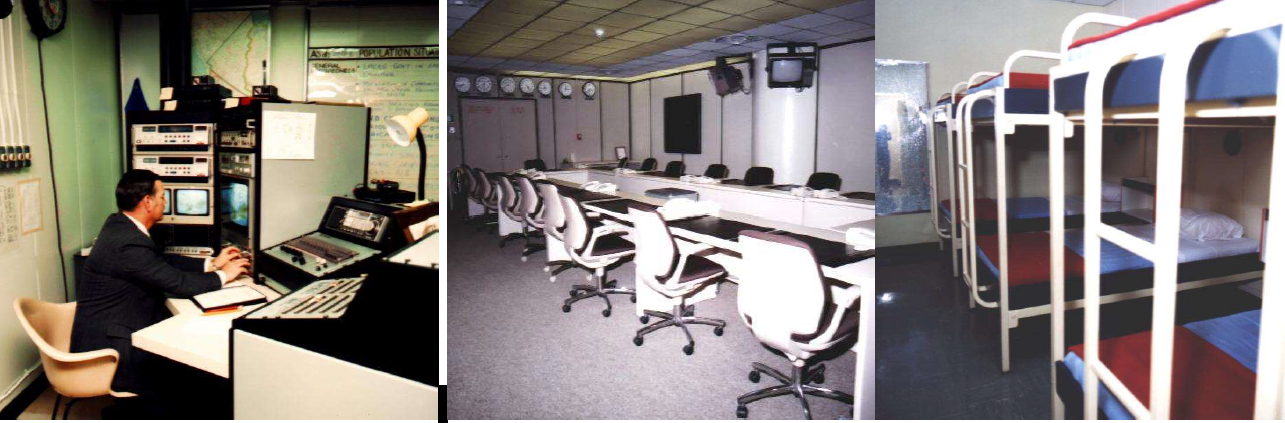
Photos from inside the operational Diefenbunker – an office, Cabinet room, bunks – click to enlarge