
Introduction:
Able Archer 83 was a ten-day NATO command post exercise starting on November 2, 1983 that spanned Western Europe. Able Archer exercises simulated a period of conflict escalation, culminating in a coordinated nuclear release. The 1983 exercise incorporated a new, unique format of coded communication, radio silences, participation by heads of government, and a simulated DEFCON 1 nuclear alert.
The realistic nature of the 1983 exercise, coupled with deteriorating relations between the United States and the Soviet Union, led some members of the Soviet Politburo to believe that Able Archer 83 was a prelude to war.
This exercise is considered by many historians to be the closest the world has come to nuclear war since the Cuban Missile Crisis of 1962. The threat abruptly ended with the conclusion of the Able Archer 83 exercise on November 11.
Backdrop:
Operation RYAN: In a May 1981 closed-session meeting of senior KGB officers and Soviet leaders, General Secretary Leonid Brezhnev and KGB chairman Yuri Andropov bluntly announced that the United States was preparing a secret nuclear attack on the USSR. To combat this threat, Andropov announced, the KGB and GRU would begin Operation RYAN. RYAN was a Russian acronym for “Nuclear Missile Attack”. Operation RYAN was the largest, most comprehensive peacetime intelligence-gathering operation in Soviet history. Agents abroad were charged with monitoring the figures who would decide to launch a nuclear attack, the service and technical personnel who would implement the attack, and the facilities from which the attack would originate. The goal of Operation RYAN was to discover the first intent of a nuclear attack and then prevent it.
Psyops:
Psychological operations by the United States began mid-February 1981 and continued intermittently until 1983. These included a series of clandestine naval operations that stealthily accessed waters near the Greenland-Iceland-United Kingdom (GIUK) gap, and the Barents,
Norwegian, Black, and Baltic seas, demonstrating how close NATO ships could get to critical Soviet military bases. American bombers also flew directly towards Soviet airspace, peeling off at the last moment.
These penetrations were designed to test Soviet radar vulnerability as well as demonstrate US capabilities in a nuclear war.
Korean Air Lines Flight 007:
On September 1, 1983 the Korean Air Lines Flight 007 (KAL 007) was shot down over prohibited Soviet airspace. All 269 passengers and crew aboard were killed. In conjunction with the PSYOPs against the Soviet Union, the attack brought relations between the two superpowers to a new low.
Weapons Buildup: The Reagan government oversaw the largest peacetime military buildup in the history of the United States. On March 23, 1983, Reagan announced one of the most ambitious and controversial components to this strategy, the Strategic Defense Initiative (labeled “Star Wars”). While Reagan viewed the initiative as a safety net against nuclear war, leaders in the Soviet Union viewed it as a definitive departure from the relative weapons parity of détente and an escalation of the arms race into space.
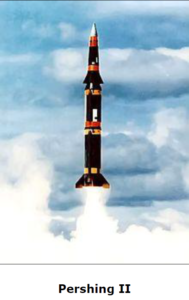 Pershing II:
Despite the Soviet outcry over the “Star Wars” program, the weapons plan that generated the most alarm among the Soviet leadership during Able Archer 83 was the planned deployment of intermediate-range Pershing II missiles in Western Europe. These missiles, deployed to counter Soviet SS- 20 intermediate-range missiles on its own western border, represented a major threat to the Soviets.
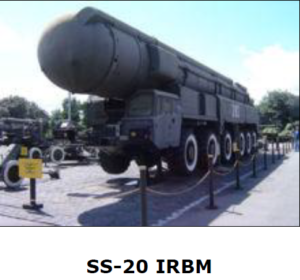 SS-20 IRBM:
The Pershing II was capable of destroying Soviet “hard targets” such as underground missile silos and command and control bunkers, and possessed a genuine “first strike capability”. Furthermore, it was estimated that the missiles (deployed in West Germany) could reach targets in the western Soviet Union within four to six minutes of their launch. These capabilities led Soviet leaders to believe that the only way to survive a Pershing II strike was to preempt it. This fear of an undetected Pershing II attack was explicitly linked to the mandate of Operation RYAN.
Exercise ABLE ARCHER 83:
Thus, on November 2, 1983, as Soviet intelligence services were attempting to detect the early signs of a nuclear attack, NATO began to simulate one.
The exercise involved numerous NATO allies and simulated NATO’s Command, Control, and Communications (C³) procedures during a nuclear war. Some Soviet leaders, because of the preceding world events and the exercise’s particularly realistic nature, believed that the exercise may have been a cover for an actual attack.
Adding to the realism of the exercise, British Prime Minister Margaret Thatcher and West German Chancellor Helmut Kohl personally participated.
Another illusory indicator noticed by Soviet analysts was an influx of ciphered communications between the United Kingdom and the United States that was interpreted as nuclear consultations. In reality, the burst of communication regarded the US invasion of Grenada, a British colony, on October 25, 1983
Finally, during Able Archer 83, NATO forces simulated a move through all alert phases, from DEFCON 5 to DEFCON 1. While these phases were simulated, alarmist KGB agents mistakenly reported them as actual.
The Soviet Union, believing its only chance of surviving a NATO strike was to preempt it, readied its nuclear arsenal. The CIA reported activity in the Baltic Military District, in Czechoslovakia, and it determined that nuclear capable aircraft in Poland and East Germany were placed on high alert status with readying of nuclear strike forces.
Soviet fears of the attack ended as the Able Archer exercise finished on November 11, and tensions between the two Alliances eased, thus bringing an end to one of the most dangerous periods of the Cold War.
References:
- http://en.wikipedia.org/wiki/Able_Archer_83
- http://www.scribd.com/doc/523029/Able-Archer-83
- http://www.historycommons.org/entity.jsp?entity=_able_archer 1
- http://www.straightdope.com/columns/read/2612/operation-able- archer
- http://coldwarhot.blogspot.com/2010/12/able-archer-1983.html
 Captain (N) (Ret’d) M. Braham, CD – Mike Braham is a graduate of the Royal Military College (1965) and a former naval officer and senior official with DND. He has an abiding interest in military history.