Originally BLOG #6 – 04 Mar 2020 from davescoldwarcanada.com.
SOXMIS. BRIXMIS, etc.

Typical Plaque on SOXMIS Cars
The Military Liaison Missions arose from reciprocal agreements formed immediately after the Second World War between the Western allied nations (U.S., UK and France) and the USSR. The missions were active from 1946 until 1990.
The agreements between the allied nations and the Soviet Union permitted the deployment of small numbers of military intelligence personnel — together with associated support staff — in each other’s territory in Germany, ostensibly for the purposes of monitoring and furthering better relationships between the Soviet and Western occupation forces. The British, French and American missions matched the size of the counterpart Soviet missions into West Germany (the nominal post-war British, French and American zones of occupations). The MLMs also played an intelligence-gathering role. The MLM teams were based in West Berlin but started their “tours” from the national mission houses in Potsdam in matte-olive-drab heavy cars. The Mission teams on a tour frequently comprised one officer accompanied by an NCO and a driver. The missions persisted throughout the Cold War period and ended in 1990 just prior to German Reunification. The missions were:
- British Commanders’-in-Chief Mission to the Soviet Forces in Germany (BRIXMIS)
- La Mission Militaire Francaise de Liaison (FMLM) more properly MMFL in French)
- U.S. Military Liaison Mission (USMLM)
- and their reciprocal Soviet missions (SOXMIS/SMLM).
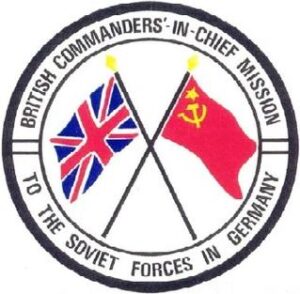 The British-Soviet missions were the first to be established (16 September 1946) under the terms of the Robertson-Malinin Agreement (the respective commanders-in-chief). It also had the largest contingent of personnel with 31 accredited team members. Later agreements with the US (Huebner-Malinin, March 1947) and France (April 1947) had significantly fewer permitted personnel, possibly because those Allied powers did not want large Soviet missions operating in their zones and vice versa. Allied personnel were warned to be on the lookout for such Soviet personnel tooling around West Germany to see what they could find.
“MOSCOW MOLLY” GIVES SECRETS OF U.S. AIR BASE – Airmen Taunted In Greenland, Former US Air Force Sergeant said here that “Moscow Molly,” a Soviet propaganda radio announcer, had taunted airmen at Thule air base in Greenland with detailed information that was supposed to he secret. Airman, Robert Guthrie (18), said the 800 men stationed at the 1top-of-the-world base were certain a spy was channelling information to the Russians. Guthrie said the propaganda siren would sometimes address an airman by name, give his hut number on the Arctic base and chat about the man’s wife and family at home. “Why don’t you go home; you could be wiped out!” Guthrie said “Molly” asked the men. He said the Soviet woman boasted that the Russians knew, what was being done at the base. Guthrie, a former tech1nical sergeant, said security officers were brought to the base and presumably investigated the broadcasts. But, he said, the men stationed at Thule never were given any hint of how Molly’s detailed information was leaking out. He said airmen believed she received the information by radio from one of the 8,500 civilian workers who built the base. However, he said he knew of no proof for that theory. Sometimes the Communist siren would inform the airmen of the arrival of planes and name the persons aboard them. “Sometimes she was right,” Guthrie said. (Trove…27 Sep 1952)