Originally BLOG #5 – 02 Mar 2020 from davescoldwarcanada.com.
Introduction (by Dave Peters)
The STRAD was an integral component of the ‘bunker’ (EASE Site / CFS Carp / CEGHQ) from 1964 to mid 1981. It was located in the space on the 400 level along the ‘back’ wall, adjacent to the Message and Crypto Centres. As a member of the Base Construction Engineering staff I remember being taken on a tour of the STRAD in 1974 (or 1975) when it was operational. It seemed to be a very busy place. Of course it was NOT the raison d’etre for the bunker (as some observers may have falsely concluded); it was however intended to be the primary means by which elements of the Emergency Government communicated with each other and so the reason for its placement in the bunker. The master control console is on display in the main hall of the Military Communications Museum in Kingston. Ms Annette Gillis, Curator for the Museum kindly sent me these images of the STRAD console on displa
When the STRAD was replaced by the SAMSON system (1981 or so), the 300 level bedrooms and offices displaced by SAMSON in what became the Ottawa Semi Automatic Exchange (OSAX) were reconstructed in the 400 level area vacated by STRAD. During the period (mid 1960s to early 1980s) of the Federal and Provincial Governments’ relative neglect of Civil Defence including the Continuity of Government Program’s Emergency Government aspects, the existence and use of STRAD is probably the only reason why the Carp facility was not closed, as it was the main Canadian military communications system during that period. Most of what follows is a condensed and edited version of what is on the RC Sigs / Military Communications Museum’s ( Kingston, Ont) website. https://www.candemuseum.org/home
Background (co-ordinating author CWO Garry Dowd (Ret’d), edited by Dave Peters)
In September 1959 under Civil Defence Order 1959, the Army was made responsible for providing warning to the public of attack and the radio-active fallout resulting from nuclear explosions and for the operation of Emergency Communications for the Government. On 31 May 1960, Prime Minister John Diefenbaker announced a plan to provide each Province with a centre from which a small core of Federal and Provincial staff and facilities supported and manned by Army personnel could direct emergency operations within the province, even in the presence of nuclear fall-out, the loss of communications and possibly the destruction of the federal capital and some provincial capitals. The army became responsible for emergency command, for attack warning, for the prediction of fall-out patterns and for a number of other important services. Planning proceeded for a network of survivable, underground and hardened shelters for the continuity of operations of the federal government and the governments of each of the provinces. Planners ensured that adequate communications capabilities with enough redundant landline telephones, cryptography machines, teleprinters, transmitters, and receivers were incorporated into the plans.
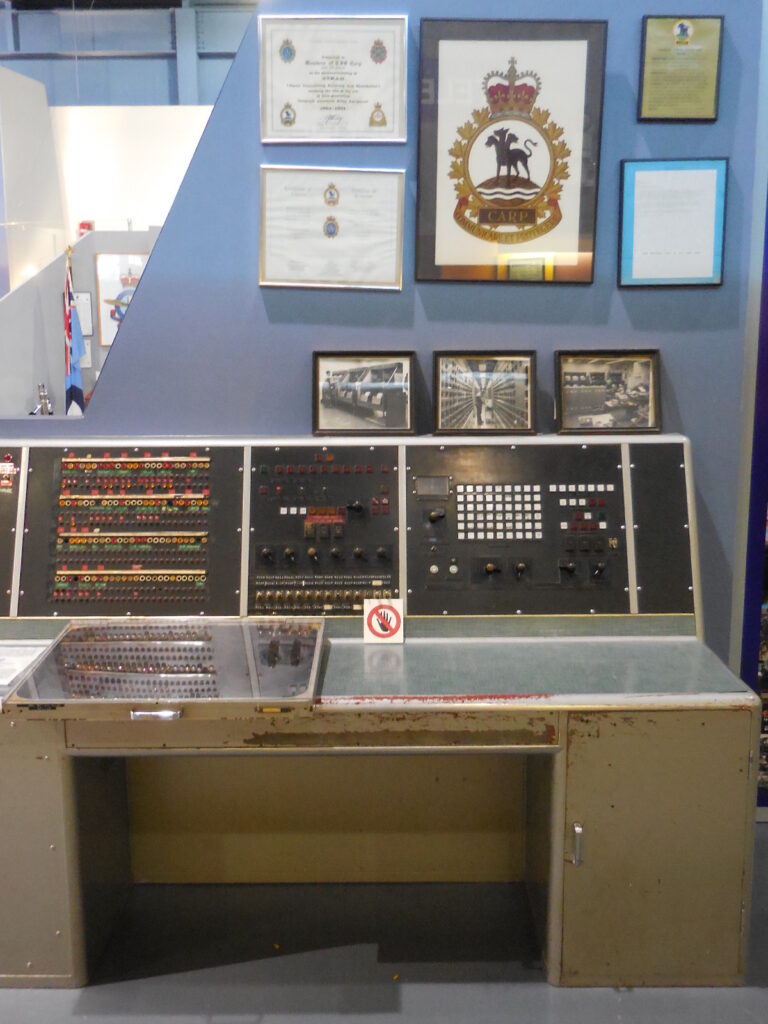
The STRAD Console
The (primary) Federal Emergency site chosen was at Carp, Ontario with Provincial sites at Borden, Shilo, Penhold, Nanaimo, Valcartier and Debert. State-of-the-art teletype and other associated communications equipment were installed in the Provincial Sites. At the Federal Site at Carp, the first computer operated message handling system called STRAD ( Signal Transmit Receive And Distribution) system was installed to control the flow of traffic through the network. The system provided a much improved service to the network users until it was retired to make way for a more modern system. The Experimental Army Signal Establishment or “EASE” became the cover name for this facility, perhaps because there was an experimental Signals facility located in nearby Shirley’s Bay, just west of Ottawa. The name for the Carp facility – the National Emergency Headquarters – was later changed to the Central Emergency Government Headquarters or “CEGHQ”. The main operating centre at Carp was called the Federal Warning Centre (FWC). It was headed by a Lieutenant Colonel, with five Majors on rotating shifts, an Artillery Sergeant as Weather and Map Plotter and five rotating shifts (Communication Operators) in the operating centre with a Sergeant as the overall daytime Supervisor.
Message Switching Automation
In the late 1950s, the British military had developed an automated message switching capability called STRAD (Signal Transmit Receive And Distribution) system and TARE (Telegraph Automatic Relay Equipment) that was based on existing procedures and which in essence automated the Tape Relay Centre (TRC) function. Messages were received on STRAD, routed by TARE and transmitted by STRAD. STRAD’s core capability was a magnetic drum storage device that recorded and stored messages prior to their onward transmission.
STRAD – Inception
On 22 Jun 1964, the Canadian Army Signal System activated a STRAD / TARE system at EASE in Carp, Ontario. The footprint of the STRAD equipment occupied 204 square meters. Carp’s STRAD was implemented to handle 69 teletype circuits and could be expanded to handle up to 90 circuits, operating at speeds of 60, 66 or 100 words per minute. The STRAD system was easily processing 9,000 messages per day, well below its maximum capacity of up to 83,000 words per minute. STRAD / TARE also saved much of the manpower required to operate the Tape Relay Centre (TRC). This was the first automated message system in the Canadian Forces, where a two or three person shift could do the operating work previously done by an entire TRC shift of a Sgt (shift supervisor) and about five TRC operators – a significant manpower savings. Based on initial success, there were discussions on implementing this STRAD / TARE system at other TRCs.
STRAD – Operations
The Carp STRAD was a first generation computer designed for use with digital communications systems. STRAD at Carp was the first installation of two similar British systems. The British system was installed at Boddington, UK and a similar system was installed in Australia. In Carp, the STRAD System was used to terminate both HF and LF radio circuits and conventional land-line circuits to all the Provincial Warning and Reporting Sites across Canada. The installation of the STRAD at Carp and the installation of more modern teletype equipment at the Nanaimo, Penhold, Shilo, Borden, Valcartier and Debert Provincial sites revolutionized the narrative message handling for the Army and other services across the nation. Concurrent with many of these happenings came the unification of the Forces with the subsequent changes to the communication system. In addition, STRAD was connected to a sister system in Boddington, UK which provided an important portal for communications to Canadian Units deployed to NATO Europe and other countries since the early 1950s.
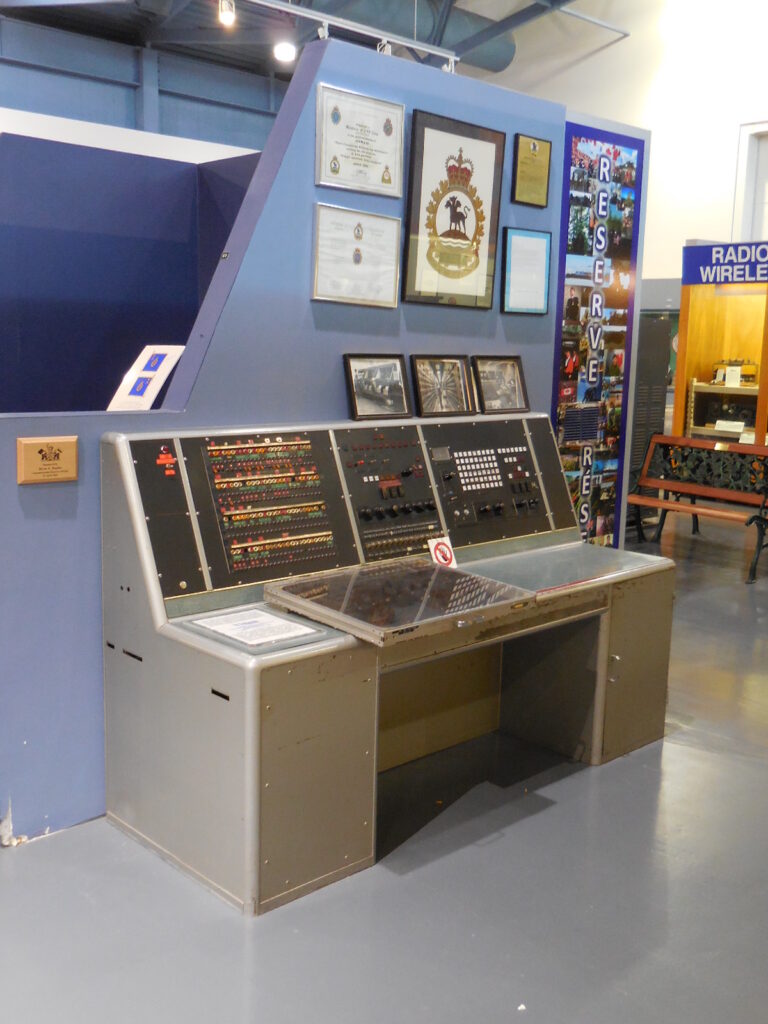
STRAD Console at the Signals Museum, Kingston
STRAD was versatile in that it was always available to accept the input of messages and would then forward them immediately or if the system became too congested, the STRAD controller could place incoming messages in overflow storage, then retrieved and forwarded later. From 1964 until decommissioned in 1981, the STRAD system proved a highly reliable and secure message system. Prior to STRAD, Canadian military communications consisted of Tape Relay Centres (TRC) and Message Centres (later known as Communication Centres). With the arrival of STRAD the whole concept of military communications changed. There were still Message Centres but the TRC was gone. No more chad tape to step on and tear. No more an abundance of tape reels to store.
STRAD – Technical
The STRAD / TARE (Signal Transmitting Receiving And Distribution) / (Telegraph Automatic Relay Equipment) system was a transistorized fixed-program automatic message handling system developed in England.. The common logic part of the system was a fully duplicated and cross wired to its identical twin. The messages received were stored on a magnetic drum. Additional storage capacity was on an overflow, magnetic tape system. On 4 January 1962 Carp went operational. All the teletype equipment was in place and the Primary TRC (pre STRAD equipment) on the 3rd floor and the Message Centre on the 4th floor were fully operational.
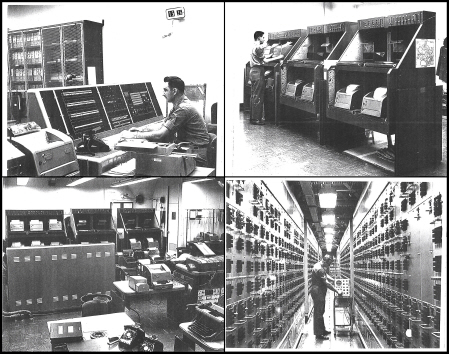
STRAD Console in the EASE Facility (upper left) and Various Associated Equipment Images
In the spring of 1962 STRAD equipment started to arrive from England however STRAD didn’t go fully operational until 1964. In October 1962 Carp had its first lockup. The Cuban Missile Crisis had the USA and its allies very concerned. (It made little difference to STRAD personnel except for not going home at night). The cabinets carrying the ‘books’ of electronic equipment were approx 3.5 feet square by 7.5 feet or so tall and weighed 1,000 to 1,500 lbs each. This equipment was unpacked in the tunnel and man handled onto a dolly and carefully taken into the site for installation. This was a very difficult and physical job. In total approx 80 cabinets were installed. (The location of these can be seen on the plastic construction model). As noted above, on 22 June 1964, the STRAD / TARE system went active.
STRAD – Closure
STRAD closure ceremonies were held on 2 July 1981 with a parade and a fly past by a T33 Shooting Star. After the parade, the STRAD equipment shut-down was carried out by with a number of highranking Comm Officers and STRAD Maintainers in attendance. STRAD / TARE closed 17 years and 61 million messages later, when the Strategic Automated Message Switching Operational Network (SAMSON) – a computerized network using modern computers – went active.