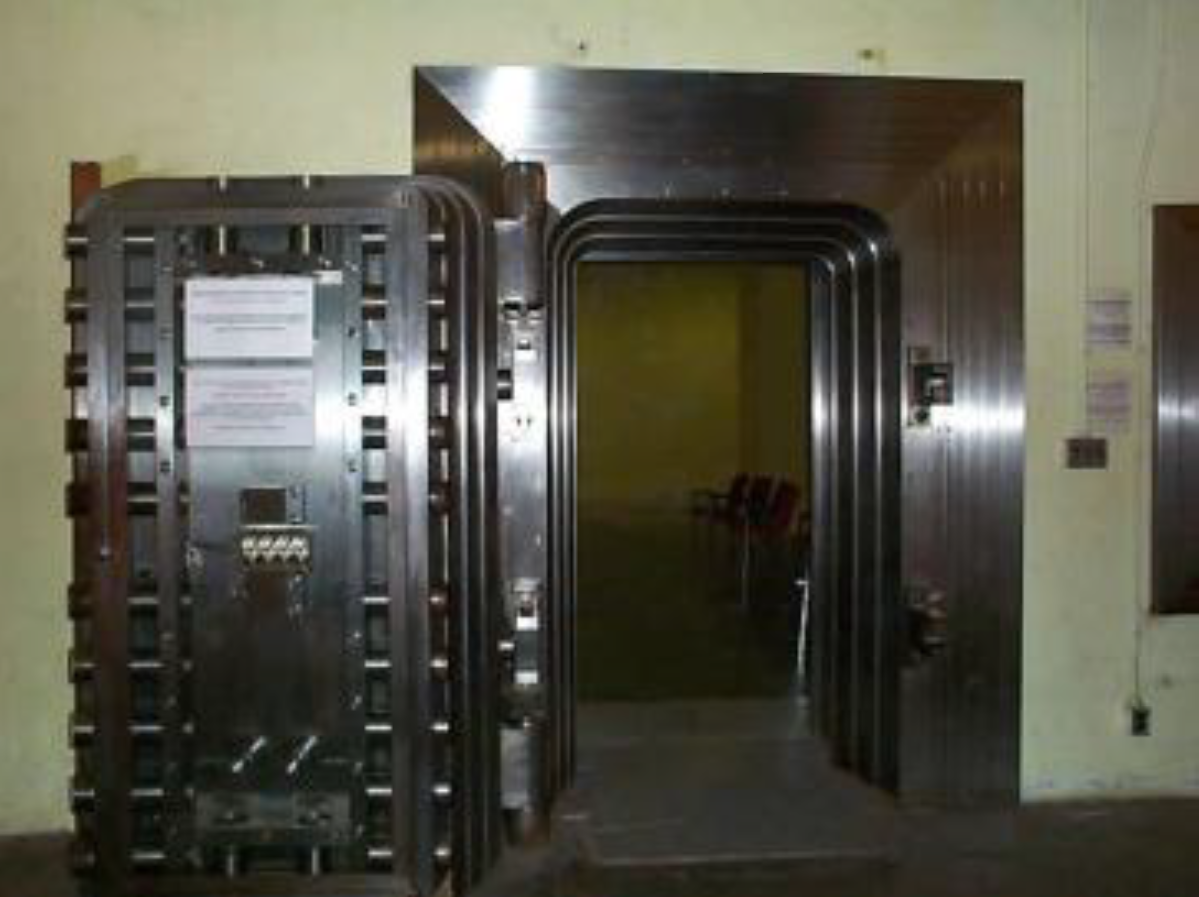
The Central Emergency Government Headquarters, also known as Canadian Forces Station Carp, or more commonly, as the Diefenbunker (named after Prime Minister John Diefenbaker) was built with two purposes in mind. The first was as a receiver station in the Canadian Forces strategic communications system. The second was as the location of the central emergency government for the continuity of constitutional government in the event of a nuclear war.
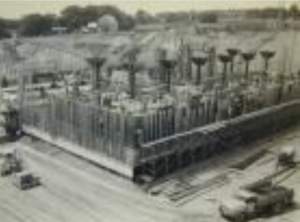 Designed by the Canadian Army, and built by a construction company from Montreal, the Diefenbunker was built between1959-1961. It was built on time and on budget for about $20M (1961). Approximately $40M worth of equipment was originally installed in the facility.
The bunker is a concrete, steel reinforced, four-storey cube fifteen to twenty feet underground. It is 155 feet square and 70 feet deep. The roof and floor of the cube are made of 5 foot thick concrete and the walls are 2.5 to 4 feet thick. Thirty-six concrete pillars from top to bottom help to support and strengthen the structure. The whole cube is encased in gravel that allows the entire structure to move several inches in the event of a nearby blast.
The Diefenbunker was designed to withstand a 5-megaton (MT) nuclear airburst from about a mile away. The bunker was built in the village of Carp, outside of Ottawa, because of its relatively safe but accessible distance from central Ottawa, the availability of deep water wells and suitable soil conditions to support a structure of this size and weight. In addition to the bunker itself, the facility includes an above-ground guard-house with its own underground mini-fallout bunker that could sustain two or three soldiers for several days. It also includes a large underground concrete garage to hold a helicopter and a couple of vehicles.
The transmitter station twinned to the receiver equipment in the Diefenbunker was located about 40 km away in Perth and was connected by underground cables. The antenna farms for the telecommunications system were located in Dunrobin and Almonte, and once again connected to the bunker by underground cables.
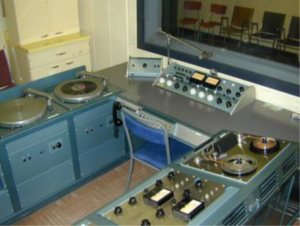 The facility operated on a 24/7 basis from the time it opened in 1961 until it closed down in 1994. The regular peacetime complement was 120 persons who were primarily military personnel required to run the communications receiver station, and to keep the facility ready in the event of an emergency.
In an emergency, the complement swelled to 535 persons, including the Governor General, Prime Minister, several federal ministers and an array of federal senior officials and bureaucrats.
The facility was designed to operate autonomously, fully closed down for thirty days. There was unlimited water available for both fire fighting and potable purposes. Fuel tanks could hold thirty days of fuel to run the four diesel generators. There was enough fresh food to last for seven days that could then be supplemented by military “Individual Meal Packs” (IMPs).
For its continuity of government role the Diefenbunker was intended to house the War Cabinet; the civil emergency government situation centre; a military situation centre; and, federal government offices. It also had accommodations and offices for the Governor General, Prime Minister, and other senior federal officials as well as accommodations, ablutions, medical and dental centres, and dining facilities for the military and civilian members who made up the complete complement of the Diefenbunker.
 Outside the bunker, but connected by a hallway at the lowest level is the Bank of Canada Vault, a concrete cube designed to hold Canada’s gold reserves in the event of nuclear war. It ceased to serve that purpose when Canada went off the gold standard in the 1970s and became instead a storage space for the bunker.
When the bunker closed in 1994, DND stripped it of all furniture and equipment in anticipation of the destruction of the facility. However, a group of concerned citizens determined to retain this important symbol of the Cold War, exerted pressure to retain the site and to convert it into the private not-for- profit museum that it became in 1998. In the same year the Diefenbunker was declared a National Heritage Site.
With much of the original equipment now returned, restored or replaced, the Diefenbunker has thrived as Canada’s Cold War Museum. Almost 45,000 visitors toured the site in 2010. A new project has recently been completed that greatly increases the capacity of the museum for visitors in the future.
For more information visit the Diefenbunker Web Site at www.diefenbunker.ca.
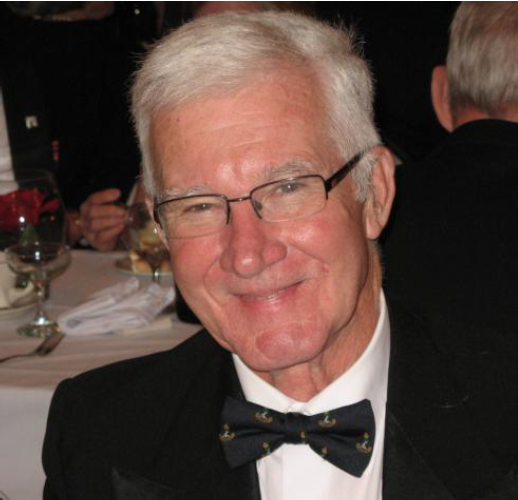 Captain (N) (Ret’d) M. Braham, CD – Mike Braham is a graduate of the Royal Military College (1965) and a former naval officer and senior official with DND. He has an abiding interest in military history.