Introduction:
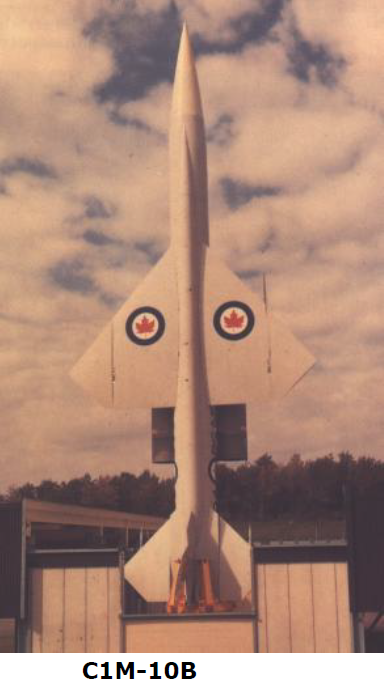
The supersonic Bomarc missiles (IM-99A and IM-99B) were the world’s first long-range anti-aircraft missiles, and the first missiles that Boeing mass produced.
Development: Boeing received a USAF contract in 1949 to develop a pilotless interceptor (a term then used by the USAF for air-defense guided missiles) under project MX-1599. The MX-1599 missile was to be a ramjet- powered, nuclear-armed long-range surface-to-air missile to defend the continental USA from high-flying bombers. The Michigan Aerospace Research Center (MARC) was added to the project soon afterwards, and this gave the new missile its name Bomarc (for Boeing and MARC). In 1951, the USAF decided to emphasize its point of view that missiles were nothing more than pilotless aircraft and anti-aircraft missiles received F-for-Fighter designations. The Bomarc became the F-99.
Test flights of XF-99 test vehicles began in September 1952 and continued through early 1955. The XF-99 tested only the liquid-fueled booster rocket, which could accelerate the missile to ramjet ignition speed. In February 1955, tests of the XF-99A propulsion test vehicles began. These included live ramjets, but still had no guidance system or warhead.
In August 1955, the USAF discontinued the use of aircraft-like type designators for missiles, and the XF-99A and YF-99A became XIM-99A and YIM-99A, respectively. In October 1957, the first YIM-99A production prototype flew with full guidance, and succeeded in passing the target within destructive range. In late 1957, Boeing received the production contract for the IM-99A Bomarc A interceptor missile, and in September 1959, the first IM-99A squadron became operational.
The liquid-fuel booster of the Bomarc A presented problems. It took 2 minutes to fuel before launch, which was too long for high-speed intercept situations, and its hypergolic fuels were very dangerous to handle, leading to several severe accidents. When high-thrust solid-fuel rockets became a reality in the mid-1950s, the USAF began to develop a new solid-fuelled Bomarc variant, the IM-99B Bomarc B. It used a Thiokol XM51 booster, and also had improved Marquardt RJ43-MA-7 ramjets. The first IM-99B was launched in May 1959, but problems with the new propulsion system delayed the first fully successful flight until July 1960, when a supersonic KD2U-1/MQM-15A Regulus II drone was intercepted.
Because the new booster took up less space in the missile, more ramjet fuel could be carried, increasing the range to 710 km (440 miles). The terminal homing system was also improved, using the world’s first pulse doppler search radar, the Westinghouse AN/DPN-53. All US Bomarc Bs were equipped with the W-40 nuclear warhead.
In June 1961, the first IM-99B squadron became operational, and Bomarc B quickly replaced most Bomarc A missiles. The IM-99B was also used by Canada, after cancellation of the advanced CF-105 Arrow manned interceptor.
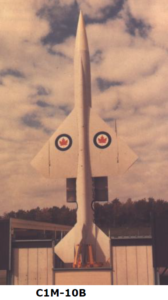 In June 1963, the IM-99A and IM-99B missiles were re-designated as CIM-10A and CIM-10B, respectively. The Bomarc A was retired soon afterwards, the last CIM-10A being phased out in December 1964. Withdrawal of the CIM-10B also began in the mid-1960s, and by 1969 most missile sites had been deactivated.
Finally, in April 1972, the last Bomarc B in USAF service was retired. The Bomarc, designed to intercept relatively slow manned bombers, had become a useless asset in the era of the intercontinental ballistic missile.
The remaining Bomarc missiles were used by all armed services as high-speed target drones for tests of other air-defense missiles. The Bomarc A and Bomarc B targets were designated as CQM-10A and CQM-10B, respectively. When production had ceased in 1965, about 700 Bomarc missiles of all versions
C1M-10B had been built by Boeing.
The Bomarc was the only surface-to-air missile ever deployed by the U.S. Air Force. All other U.S. land-based SAMs were under the control of the U.S. Army.
 Operation:
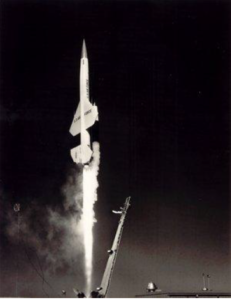
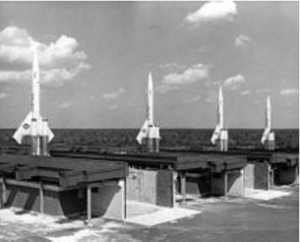
The operational Bomarc missiles were based horizontally in semi-hardened shelters (“coffins”). After the launch order, the shelter’s roof slid open, and the missile was raised into the vertical position. After the missile’s booster was fuelled, it was launched by the Aerojet General LR59-AJ-13 booster.
When supersonic speed was reached, the Marquardt RJ43-MA-3 ramjets would ignite and propel the missile to its cruise speed and altitude of Mach 2.8 at 20000 m (65000 ft).
The Bomarc was guided to the target by ground commands from SAGE (Semi- Automatic Ground Environment), whose long-range radars tracked the enemy aircraft and the interceptor aircraft and missiles. When the Bomarc was within 16 km (10 miles) of the target, its own Westinghouse AN/DPN-34 radar guided the missile to the interception point.
The maximum range of the Bomarc was 400 km (250 miles), and it was fitted with either a conventional high-explosive or a 10 kT W-40 nuclear fission warhead.
 THE BOMARC MISSILE CRISIS
In 1958 the Diefenbaker government was faced with two feasible courses of action for a renewed air defence strategy. One was to complete the Avro Arrow production run at the staggering cost of $12.5 million for each aircraft. The alternative was to cancel the project and to buy from the US two relatively cheap Bomarc-B nuclear surface-to-air missile installations, their complementary command and control system and 100 US-built interceptors at a greatly reduced cost of $2 million each.
On September 23, 1958, Diefenbaker announced that Canadian air defence requirements were to be revised because of the perceived, diminished Soviet bomber threat. Two Bomarc-B bases would be built, the Astra I and Sparrow II missile programmes were cancelled, but because of serious unemployment in the Toronto area a decision as to what interceptor (subsequently the CF-101 Voodoo) to procure was postponed for six months.
This controversial defence decision was one of many flowing from the 1957 NORAD agreement with the US. It was argued that the surface-to-air guided missile would be an effective replacement for the manned Avro Arrow, which was scrapped.
Fifty-six missiles were deployed at 446 Squadron, North Bay, Ontario, and 447 Squadron, La Macaza, Québec, under the ultimate control of the commander in chief, NORAD.
Unfortunately, the Canadian government did not make it clear that the version to be acquired, the Bomarc-B, was to be fitted with nuclear warheads. When this became known in 1960 it gave rise to a heated debate as to whether Canada should adopt nuclear weapons. The Conservative government could not bring itself to accept nuclear warheads for the Bomarcs. The ensuing dispute split the Diefenbaker Cabinet, and led to the collapse of the government in 1963.
With the Conservatives’ fall in 1963 and the Liberals’ return to power under Lester Pearson, a decision was made to accept nuclear warheads for Canadian nuclear-capable forces, and the Bomarc warheads were delivered to their sites on 31 December 1963. Nevertheless, the decision was made reluctantly, and in 1969 Pierre Trudeau’s new Liberal government announced that Canada would withdraw the nuclear role from its Armed Forces. As part of this process the Bomarc missile was phased out of Canadian service by 1971.
As stated in 1971 White Paper on Defence: “The BOMARC missiles sited in Canada were a relatively important contribution in the days when a full anti- bomber defence existed to defend urban-industrial targets as well as to protect the deterrent which consisted largely of the U.S. bomber force. The deployment by the U.S.S.R. of a missile force numbering in the thousands has altered considerably the strategic situation. The BOMARCs have become highly vulnerable to a missile attack since they cannot be dispersed like Aircraft. Moreover, the Canadian BOMARCs are sited to defend the eastern part of North America whereas the preponderance of the U.S. land-based strategic retaliatory forces is located in the mid-west. Since no comprehensive defence of population against missile attack is likely to be available in the foreseeable future, the Government has concluded there is no longer sufficient reason to continue to deploy BOMARCs in Canada, and this system will therefore be retired.”
Bomarc Specifications
|
CIM-10A |
CIM-10B |
|
|
Length |
14.2 m (46 ft 9 in) |
13.7 m (45 ft 1 in) |
|
Wingspan |
5.54 m (18 ft 2 in) |
|
|
Diameter |
0.89 m (35 in) |
|
|
Weight |
7020 kg (15500 lb) |
7250 kg (16000 lb) |
|
Speed |
Mach 2.8 |
Mach 3 |
|
Ceiling |
20000 m (65000 ft) |
30000 m (100000 ft) |
|
Range |
400 km (250 miles) |
710 km (440 miles) |
|
Propulsion |
Boost: Aerojet General LR59-AJ- 13 liquid-fuel rocket; 156 kN (35000 lb) Sustain: 2x Marquardt RJ43-MA- 3 ramjet; 51 kN (11500 lb) each |
Boost: Thiokol M51 solid-fuel rocket; 222 kN (50000 lb) Sustain: 2x Marquardt RJ43- MA-7 ramjet; 53 kN (12000 lb) each |
|
Warhead |
W-40 nuclear fission (7-10 kT); CIM-10A had option for conventional HE |
|
 Captain (N) (Ret’d) M. Braham, CD – Mike Braham is a graduate of the Royal Military College (1965) and a former naval officer and senior official with DND. He has an abiding interest in military history.