Introduction:
The Avro Canada CF-100 takes its place in Canadian aviation history as the only home-grown interceptor design to attain operational status. Between 1950 and 1958, 692 CF-100s were built and flown by nine Canada-based RCAF all-weather fighter squadrons, and four European-based squadrons. Fifty- three CF-100s were sold to Belgium, the only other country to use the aircraft operationally.
Although conventional in appearance, the CF-100 was superior to other contemporary Allied all-weather aircraft. Its good short field performance, low- speed handling qualities, long range, fast rate of climb, two-man crew, and excellent fire control system provided the CF-100 with overall capabilities unmatched by any other all-weather interceptor of the period.
Known affectionately as the “Clunk” by its aircrews, or disparagingly as the heavy metal “Lead Sled” by F-86 pilots, the CF-100 was the most effective all-weather fighter in the West’s inventory during the 1950s. (The “Clunk” nickname arose from the noise the front landing gear made as it retracted into its well after takeoff.)
The CF-100 Mark 1 prototype, “18101”, emerged from the factory painted gloss black overall with white lightning bolts running down the fuselage and engines, and flew its maiden flight on January 19, 1950.
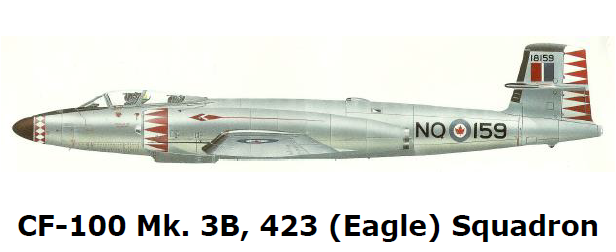
The first production version, designated Mk. 3, incorporated the APG-33 radar and was armed with eight 50-cal. machine guns. The Mk.3 entered service in 1953 and 70 were built. In service, the Mark 3 was promising, but it suffered from a number of teething problems, leading it to serve primarily as a training and evaluation machine.
CF-100 Mk. 3B, 423 (Eagle) Squadron
The improved Mark 4 featured a windscreen between the forward and rear halves of the cockpit to make ejection easier for the back-seat aircrew. A one-piece canopy was also introduced.
It also had upgraded twin Orenda 9 engines that required modified engine nacelles.
A new Hughes MG-2 collision-course fire-control system, with AN/APG-40 radar was accommodated in a bigger nose. Wingtip pods with 29 Mighty Mouse rockets each, which could be swapped with wingtip tanks for ferry flights were also added.
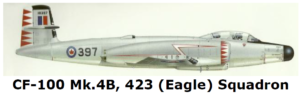
CF-100 Mk.4B, 423 (Eagle) Squadron
The final, improved Mark 5 that included better high altitude performance was introduced in 1955.
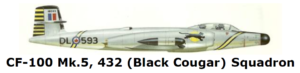
CF-100 Mk.5, 432 (Black Cougar) Squadron
Operational History:
The air force began CF-100 operations in 1952 at RCAF Station North Bay. The CF-100 was officially retired in October, 1981.
During its service, the aircraft operated under the US/Canadian North American Air Defence Command (NORAD) to protect North American airspace from Soviet intruders such as nuclear-armed bombers.
Additionally, as part of NATO, four CF-100 squadrons were based in Europe with 1 Air Division from 1956–1962, and were for some time the only NATO fighters capable of operating in zero visibility and poor weather conditions.
The CF-100 served with nine RCAF squadrons at its deployment peak in the mid- 1950s.
In the CF-100’s lifetime, 692 models of different variants were produced, including the 53 aircraft delivered to the Belgian Air Force. Although the airframe was originally designed for only 2,000 hours, experience proved that it could serve for a remarkable 20,000 hours-plus before retirement.
Many of the innovations in radar and quick-change weaponry that were developed on the CF-100, and some of its design features, were incorporated into the ill-fated Avro CF-105 Arrow.
SPECIFICATIONS – CF-100 Mk. 5
General characteristics
-
Crew: 2, pilot and navigator
-
Length: 16.5 m (54 ft 2 in)
-
Wingspan: 17.4 m (57 ft 2 in)
-
Height: 4.4 m (14 ft 6 in)
-
Wing area: 54.9 m² (591 ft²)
-
Empty weight: 10,500 kg (23,100 lb)
-
Loaded weight: 15,170 kg (33,450 lb)
-
Powerplant: 2× Avro Canada Orenda 11 turbojets, 32.5 kN (7,300 lbf) each
Performance
-
Maximum speed: 888 km/h (552 mph)
-
Range: 3,200km (2,000mi)
-
Service ceiling: 13,700 m (45,000 ft)
-
Rate of climb: 44.5 m/s (8,750 ft/min)
-
Thrust/weight: 0.44
Armament
 Captain (N) (Ret’d) M. Braham, CD – Mike Braham is a graduate of the Royal Military College (1965) and a former naval officer and senior official with DND. He has an abiding interest in military history.