
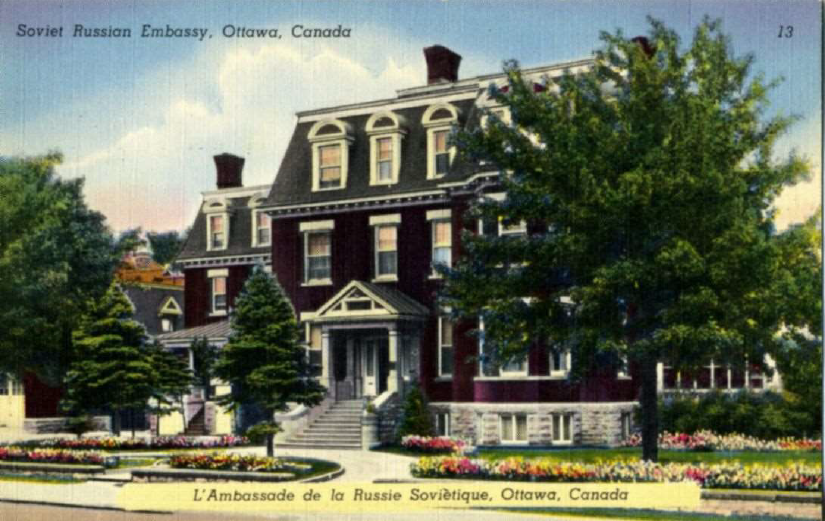
Postcard of the Soviet embassy Ottawa – click to enlarge
The site was originally given to the Soviet Union in 1942. It contained a large manor that had formerly belonged to J. Fred Booth, son of lumber baron J.R. Booth. This manor had been the site of the marriage of Fred Booth’s daughter Lois to Prince Erik of Denmark, son of Prince Valdemar of Denmark. The building was expropriated by the government during the Second World War for use by the navy, but was instead handed over to the Soviets to house their growing legation. It was in this building that Igor Gouzenko worked and from where he removed documents before defecting in 1945.
A fire broke out at the Soviet Embassy on Charlotte Street on January 1, 1956. When the fire began, Embassy staff attempted to put it out themselves. 40 minutes later, the fire department was called in.
Firefighters who came to the scene experienced a new challenge. They were not allowed to enter the building and could not bring their equipment very close to the fire because of a large fence, and the police had no authority to help them gain access. Meanwhile, embassy staff were ferrying documents, furniture, and other valuables from the building while dodging pieces of falling debris.
Mayor Whitton and Paul Martin Sr. rushed to the scene as representatives of the City and the Department of External Affairs. After tense negotiations with the Russian Ambassador, the fire department was finally granted access. By this time, the fire had been burning intensely for over an hour and it was too late to save the building. It took almost six hours and the entire fire department to put it out.
The embassy was destroyed. Besides illustrating the tensions of the Cold War, for many people in Ottawa it was a lesson in the extra-territorial rights of embassies and their staff. The land that embassies are located on is technically considered the territory of that country. The only way the fire department could have forced their way in that night was if the fire posed a specific risk to Canadian life and property. Laws remain the same today.
The fire was caused by an electrical short circuit in the embassy’s communications room located on the upper floor of the three-storey building. Instead of immediately calling the Ottawa Fire Department for assistance, Soviet diplomats tried to put out the blaze themselves using hand extinguishers and a small fire hose installed in the building. Thirty minutes passed before the alarm was raised. Although firefighters were on the scene within ten minutes of receiving the call, flames had already engulfed the third floor.
Entering by the front door of the embassy, Ottawa’s firemen, led by Chief John Foote, were stopped by embassy staff claiming diplomatic immunity. A Soviet official actually struck Chief Foote; the incident was later played down. Denied access to source of the fire, the firemen were obliged to tackle the blaze from the outside. The Soviet diplomats also impeded the firemen’s efforts by refusing to vacate the premises. Instead, they repeatedly went in and out of the embassy to retrieve filing cabinets, boxes, and files of documents. The last item to be saved from the flames was “a heavy piece of wireless equipment.” Two embassy cars, stuffed with documents, reportedly “careened” out of the embassy driveway onto Charlotte Street, running over deployed fire hoses, almost bursting them.
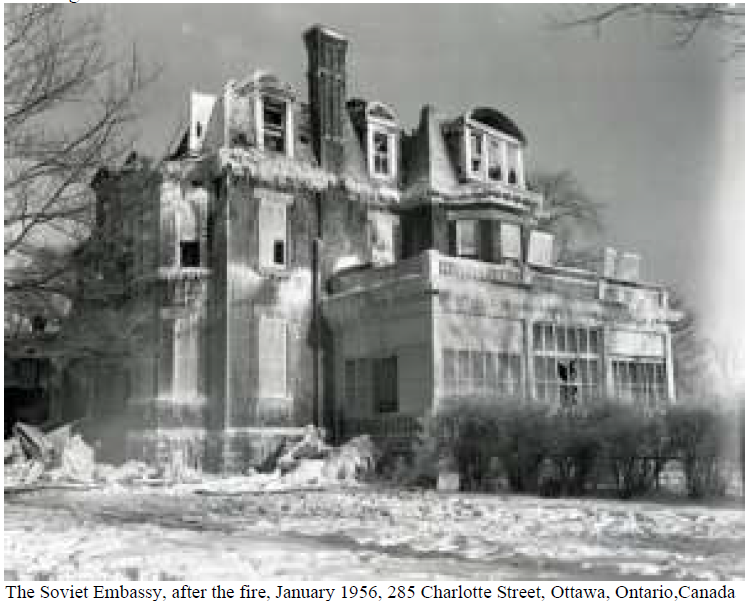
The Soviet Embassy, after the fire, January 1956, 285 Charlotte Street, Ottawa, Ontario, Canada – click to enlarge
Incensed by the lack of Soviet co-operation, Chief Foote contacted Mayor Whitton who hurried to the scene. Shortly afterwards, R. M. Macdonnell, the deputy undersecretary of External Affairs arrived, as did Paul Martin, Sr, Minister for National Health and Welfare, substituting for Lester Pearson, Minister for External Affairs who was out of town. The mayor authorized Chief Foote to exercise all necessary emergencies powers at his disposal as Fire Marshal. At 6.30pm, he declared a state of emergency, calling in extra firemen and police support.
The fire was finally brought under control two hours later, but was not extinguished until close to midnight. One hundred firemen fought the blaze in biting cold weather, using equipment from four stations, including three pumper trucks and four ladder trucks.
Although smoke and hot cinders filled the sky, a north-easterly breeze blew burning embers towards parkland and the Rideau River, sparing the embassy’s neighbours. More than three thousand spectators watched the night’s drama despite the cold. Hundreds of cars lined Riverside Drive. Meanwhile, streetcar service along Laurier Avenue East was blocked.
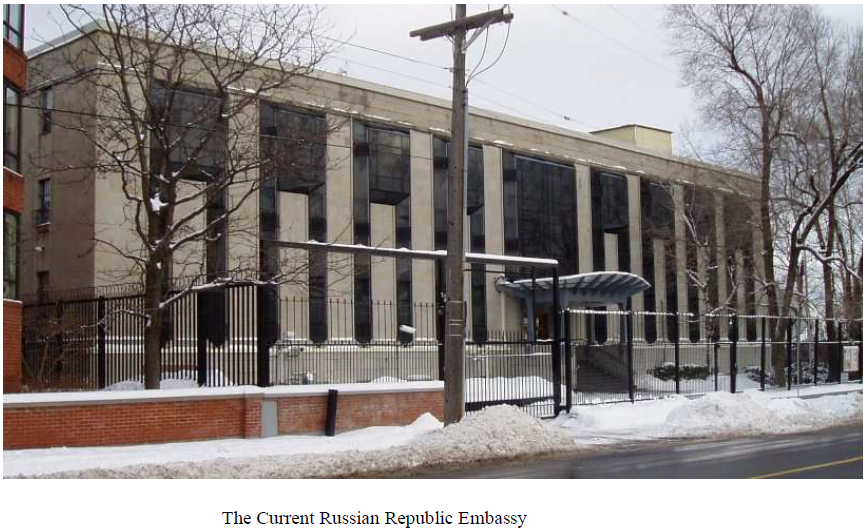
The Current Russian Republic Embassy – click to enlarge
The remains of the manor were demolished and the current stark Soviet style building was erected in its place. The Canadian security service, in cooperation with MI5, infiltrated the construction site in an attempt to bug the building in an operation that was known as Operation Dew Worm. They concentrated on the northwest corner of the building, the logical site for a communications centre. The Soviets, however, built their communications centre in a sealed chamber elsewhere in the building and the bugs proved useless.
With the fall of the Soviet Union the building became the Russian embassy. The massive bust of Lenin was removed from the lobby and soon after the building’s exterior was modified to make it less imposing.
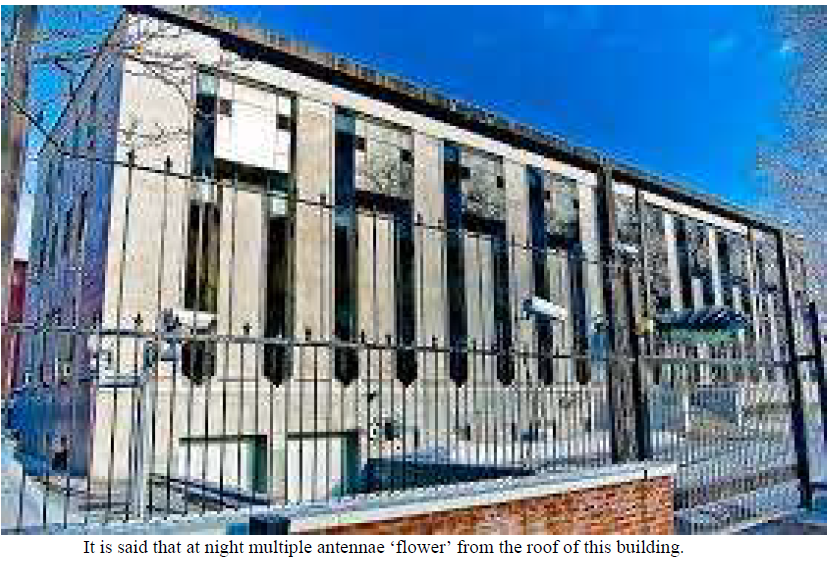
It is said that at night multiple antennae ‘flower’ from the roof of this building. – click to enlarge