Introduction:
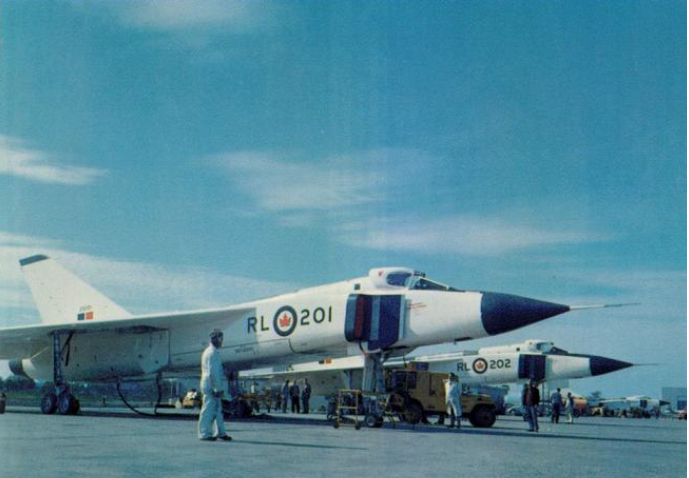
The Avro Canada CF-105 Arrow was a delta-winged interceptor aircraft, designed and built by Avro Aircraft Limited (Canada). The CF-105 was intended to serve as the Royal Canadian Air Force’s (RCAF) primary interceptor in the 1960s and beyond.
Not long after the start of its flight test program, the development of the Arrow (including its Orenda Iroquois jet engines) was abruptly and controversially halted, sparking a long and bitter political debate.
Specification AIR 7-3:
Intensive discussions between Avro and the RCAF examined a wide range of alternative sizes and configurations for a supersonic interceptor, culminating in RCAF “Specification AIR 7-3” in April 1953.
AIR 7-3 called for a crew of two, twin engines, a range of 300 nautical miles (556 km) for a normal low-speed mission, and 200 nmi (370 km) for a high- speed interception mission. It also specified operation from a 6,000 ft (1,830 m) runway; a Mach 1.5 cruising speed at an altitude of 70,000 ft (21,000 m); and manoeuvrability for 2 g turns with no loss of speed or altitude at Mach 1.5 and 50,000 ft. The specification required five minutes from starting the aircraft’s engines to reaching 50,000 ft altitude and Mach 1.5. It was also to have turn-around time on the ground of less than 10 minutes.
An RCAF team visited U.S. aircraft producers and surveyed British and French manufacturers before concluding that no existing or planned aircraft could fulfill these requirements.
Avro submitted their modified C105 design in May 1953. The engines considered for the aircraft were the Curtiss Wright J-67, the Bristol Olympus OL-3 or the Orenda TR.9 engines. Armament was to be stored in a large internal bay located in a “belly” position, taking up over one third of the aircraft fuselage. A wide variety of weapons could be deployed from this bay, such as the Hughes Falcon guided missile, the CARDE Velvet Glove air to air missile, or four general-purpose 1,000 lb bombs. The Velvet Glove radar- guided missile had been under development with the RCAF for some time, but was proven unsuitable for supersonic speeds and lacked development potential, consequently further work on that project was cancelled in 1956.
In July 1953, the proposal was accepted and Avro was given the go-ahead to start a full design study under the project name: “CF-105”. In December,
$27 million was provided to start flight modelling. At first, the project was limited in scope, but the introduction of the Soviet M-4 Bison jet bomber and the Soviet Union’s testing of a hydrogen bomb dramatically changed Cold War priorities. In March 1955, the contract was upgraded to $260 million for five Arrow Mk. 1 flight-test aircraft, to be followed by 35 Arrow Mk. 2s with production engines and fire-control systems.
Production and Testing:
To meet the timetable set by the RCAF, Avro decided that Arrow program would eliminate the prototype phase, with the first test airframes constructed on production jigs. Any changes would be incorporated into the jigs while testing continued, with full production starting when the test program was complete.
By mid-1954, the first production drawings were issued and wind tunnel work began, along with extensive computer simulation studies carried out both in Canada and the United States utilizing sophisticated computer programs. Experiments showed the need for only a small number of design changes, mainly involving the wing profile and positioning.
In 1954, the RB.106 engine program was cancelled, necessitating the use of the backup J67 engine instead. In 1955, this engine was also cancelled, leaving the design with no engine. At this point, the Pratt & Whitney J75 was selected for the initial test-flight models, while the new TR 13 engine was developed at Orenda for the production Mk 2s.
Meanwhile, the Astra fire control system proved to be problematic as the system ran into a lengthy period of delays, and when the USN cancelled the Sparrow II in 1956, Canadair was quickly brought in to continue the Sparrow program in Canada, although they expressed grave concerns about the project as well and the move added yet more expense.
Go-ahead on the production was given in 1955. The rollout of the first CF- 105, marked as RL-201, took place 4 October 1957. The company had planned to capitalize on the event, inviting more than 13,000 guests to the occasion. Unfortunately for Avro, the media and public attention for the Arrow rollout was dwarfed by the launch of Sputnik the same day.
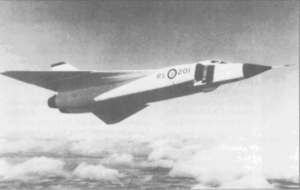
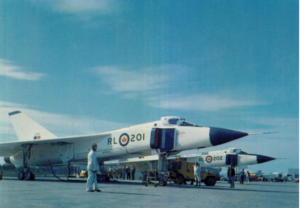 RL-201 first flew on 25 March 1958 with Chief Development Test Pilot Squadron Leader (S/L) Janusz Żurakowski at the controls. Four more J75-powered Mk 1s were delivered in the next 18 months. The test flights, limited to “proof-of-concept” and assessing flight characteristics, revealed no serious design faults. The aircraft went supersonic on its third flight and, on the seventh, broke 1,000 mi/h (1,600 km/h) at 50,000 ft (15,000 m), while climbing and accelerating.
By February 1959, the five aircraft had completed the majority of the company test program and were progressing to the RCAF acceptance trials.
Cancellation:
In June 1957 when the governing Liberals lost the federal election and a Progressive Conservative government under John Diefenbaker took power, the aircraft’s fate began to noticeably change. Diefenbaker had campaigned on a platform of reining in what the Conservatives claimed was “rampant Liberal spending.”
A criticism voiced in the 1950s in the media was that Avro Canada as a company had little interest in competing with its products on the market, and instead had come to rely solely upon the availability of government financing for its activities.
In August 1957, the Diefenbaker government signed the NORAD (North American Air Defense) Agreement with the United States, making Canada a partner with American command and control. The USAF was in the process of completely automating their air defense system with the SAGE project, and offered Canada the opportunity to share this sensitive information. One aspect of the SAGE system was the BOMARC nuclear-tipped anti-aircraft missile. This led to studies on basing BOMARCs in Canada in order to push the line further north, however the deployment was evaluated as being extremely costly.
Defence against ballistic missiles was also becoming a priority. The existence of Sputnik had raised the spectre of attack from space, and, as the year progressed, word of a “missile gap” began spreading.
On 11 August 1958, Defence Minister Pearkes requested cancellation of the Arrow, but the Cabinet Defence Committee (CDC) refused. He tabled it again in September, and recommended installation of the Bomarc missile system. The latter was accepted but, again, the CDC refused to cancel the entire Arrow program. The CDC wanted to wait until a major review in 31 March 1959. Efforts to continue the program through cost-sharing with other countries were then explored.
Canada tried to sell the Arrow aircraft to the U.S. and Britain, but had no takers. The aircraft industry in both countries was considered a national interest and the purchase of foreign designs was rare.
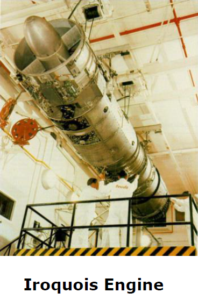
Acting on media speculation that the Iroquois engine program was also in jeopardy of being cancelled, the French government whose original intention was to place a major order for 300 Iroquois engines for the Dassault Mirage IV bomber, chose to end negotiations in October 1958 and opted for the indigenous SNECMA Atar engine.
Iroquois Engine
The Arrow’s cancellation was announced on 20 February 1959. The day became known as “Black Friday” in the Canadian aviation industry.
|
‘The government… has made a thorough examination in the light of all the information available concerning the probable nature of the threats to… North America in the future years, the alternative means of defence against such threats, and the estimated cost thereof. The conclusion arrived at is that the development of the Arrow aircraft and Iroquois engine should be terminated now.’ |
|
—Prime Minister Diefenbaker addressing the House of Commons, 20 February 1959. |
The decision to terminate the program immediately put 14,528 Avro employees out of work, as well as nearly 15,000 other employees in the Avro “supply chain” of outside suppliers.
An attempt was made to provide the completed Arrows to the National Research Council of Canada as high-speed test aircraft. The NRC refused, noting that without sufficient spare parts and maintenance, as well as qualified pilots, the NRC could make no use of them.
Within two months of the project cancellation, all aircraft, engines, production tooling and technical data were ordered scrapped. Officially, the reason given for the destruction order from Cabinet and the Chiefs of Staff was to destroy classified and “secret” materials utilized in the Arrow/Iroquois programs. The action has been attributed to Royal Canadian Mounted Police fears that a Soviet “mole” had infiltrated Avro.
In 1961, the RCAF obtained 66 CF-101 Voodoo aircraft, one of the American designs the RCAF originally rejected, to serve in the role originally intended for the Avro Arrow. The controversy surrounding this acquisition, and Canada’s acquiring nuclear weapons for the Voodoos and Bomarcs eventually contributed to the collapse of the Diefenbaker government in 1963.
 Captain (N) (Ret’d) M. Braham, CD – Mike Braham is a graduate of the Royal Military College (1965) and a former naval officer and senior official with DND. He has an abiding interest in military history.