
Introduction:
The MGR-1 Honest John rocket was the first nuclear-capable surface-to-surface rocket in the US arsenal.
Development & Operations: Designated Artillery Rocket XM31, the first rocket was tested 29 June 1951 and the first production rounds were delivered in January 1953. The designator was changed to M31 in September 1953. The first US Army units received their rockets by year’s end and Honest John battalions were deployed to Europe in the Spring of 1954.
Developed at Redstone Arsenal, Alabama, Honest John was a large but simple fin-stabilized, unguided artillery rocket weighing 5820 pounds in its initial M-31 nuclear-armed version. Mounted on the back of a truck, it was aimed in much the same way as a cannon and then fired up an elevated ramp, igniting four small spin rockets as it cleared the end of the ramp.
The M-31 had a range of 15.4 miles with a 20 kiloton nuclear warhead but was also capable of carrying a 1500 pound conventional warhead.
Development of an upgraded Honest John, M-50, was undertaken to improve accuracy and extend range.
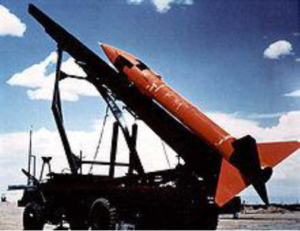 Honest John consisted of a truck-mounted, unguided, solid-fueled rocket transported in 3 separate parts. Before launch they were combined in the field, mounted on an M289 launcher and aimed and fired in about 5 minutes. The rocket was originally outfitted with a W7 variable yield nuclear warhead with a yield of up to 20 kilotons of TNT and later a W31 warhead with three variants was deployed with yields of 2 kt, 10 kt, or 30 kt. In the 1960s Sarin nerve gas cluster munitions were also available for Honest John.
The 2 basic versions of Honest John were:
- MGR-1A (M31) was 27ft 3in long, had an engine diameter of 22.875in, a warhead diameter of 30in (762mm), a span of 104in, weighed 5820 pounds (nuclear), and had a maximum range of 15.4 miles. The Hercules Powder Company X-202 rocket motor was 197.44in long, weighed 3937 pounds, and had 90,325 pounds average thrust.
- MGR-1B (M50) was 24ft 10.53in long, had an engine diameter of 22.8in, a warhead diameter of 30in, a span of 56in, weighed 4332 pounds (nuclear), and had twice the range of the M31. The Thiokol composite propellant solid rocket motor had 150,000 pounds thrust.
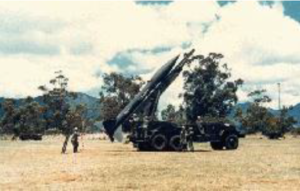 Production of the MGR-1 variants finished in 1965 with a total production run of more than 7,000 rockets. Honest John’s bulbous nose and distinctive truck-mounted launch ramp made it an easily recognized symbol of the Cold War. The system was replaced with the MGM-52 Lance missile in 1973, but was deployed with NATO units in Europe until 1985. Conventionally armed Honest John remained in the arsenals of Greece, Turkey and South Korea until the late 1990s.
By the time the last Honest Johns were withdrawn from Europe in 1985, the rocket had served with the military forces of Belgium, Britain, Canada, Denmark (non-nuclear), France, Germany, Greece, Italy, the Netherlands, Norway (non-nuclear), South Korea, Taiwan (non-nuclear), and Turkey.
Canadian Use of Honest John:
In 1962, John Diefenbaker’s government approved the purchase of the “Honest John” for NATO service in Germany.
The Honest John was one of several nuclear capable systems authorized by the Conservative regime of the time, the others being the BOMARC surface- to-air missile (SAM), the Genie air-to-air missile (AAM) used by the CF 101 Voodoo, and the earliest of the four types of nuclear bombs carried by the CF 104 Starfighters in Europe.
The actual provision of nuclear warheads for these systems was a dominant theme of the 1963 General Election. The Canadian air force assumed responsibility for the BOMARC missile system. The Honest John was the army’s sole nuclear-capable delivery system responsibility.
The creation, in September 1960 of the army’s two SSM Batteries – one for deployment and one for training – occurred simultaneously with disbandment of the army’s anti-aircraft artillery school and the 1st Light Anti-Aircraft Regiment. The two SSM Batteries not only took over the space that these organizations occupied at Camp Picton in the fall of 1960, but also a great many of the personnel.
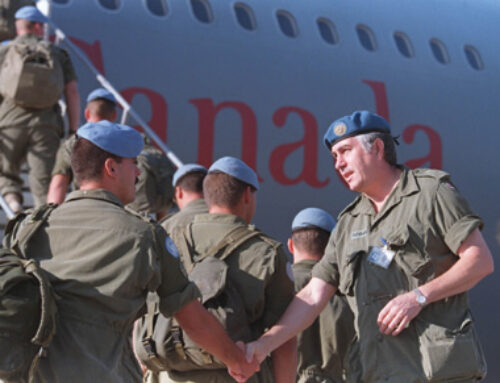
Training on the Honest John system took place in April and May of 1961 in Fort Sill, home of American artillery. On October 27, an Honest John missile was fired at Camp Petawawa, the first by the 1st SSM Battery, Royal Canadian Artillery. In December, 1961 over 225 men of the 1st SSM Battery were deployed to Hemer, Germany, to become part of the British Army of the Rhine under command of the brigadier commanding 4th Canadian Infantry Brigade (4 CIBG).

1 SSM Formation Patch
The 1st SSM Battery had four launchers. The role of the missiles was counter battery and harassment. Canadians in Europe used the warhead with a 2kt yield.
1st SSM had 115 “operational” missiles and a reported 16 nuclear warheads available from 69 US Army Missile Warhead Support Detachment of the US Army Special Ammunition Storage Command.
Unlike the aircraft of the Royal Canadian Air Force, Canadian SSM units had to obtain the nuclear warheads from this American custodian detachment co-located with the British Corps, which included 4 CIBG.
Authorization for release of nuclear warheads would come directly to the American storage unit in event of a “first strike” situation. The authority for nuclear warhead release, in most circumstances, was expected to be the Supreme Allied Commander Europe (SACEUR) who would also pass authority to use the nuclear warheads to the Canadian SSM Battery through the Commander 4 CIBG.
There was also a process for the Canadian prime minister to authorize this use by the Canadian missile unit.
The 1st Canadian SSM Battery, although an artillery element, did not come under the purview of 4 CIBG’s senior artillery officer, the commanding officer of 4 Royal Canadian Horse Artillery Regiment (4 RCHA). The officer commanding the Battery received instructions directly from Canada’s brigade commander.
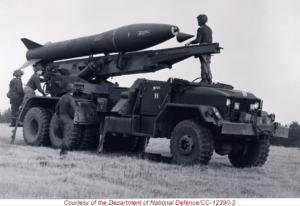 The 2nd SSM Battery, with two launchers, was created to provide trained personnel for Europe. In August 1962, 2nd SSM Battery was moved from Picton to CFB Shilo where it remained until disbandment in September 1968. That same year, 1st SSM Battery was reduced to two launchers and moved from Hemer to Isherlohn. In 1970, this Battery was also disbanded.
 Captain (N) (Ret’d) M. Braham, CD – Mike Braham is a graduate of the Royal Military College (1965) and a former naval officer and senior official with DND. He has an abiding interest in military history.