
Background
The underground facility at Carp was ostensibly built as the Experimental Army Signals Establishment (EASE). The word ostensibly is used because while it was one of the most important Canadian military telecommunications sites for military message traffic during most of its existence it was also the primary site for the federal government’s emergency operations in the event of a nuclear attack on North America. Whatever the cover story it did make a good deal of sense to co-locate the government’s emergency operations capability with the military’s strategic telecommunication function because it would have been impossible for the government to be at all effective in the absence of good communications.
Redundancy
The facility had built-in a great deal of redundancy of telecommunications capability, not only with respect to the numbers and types of systems but also in terms of backups and alternate routes of transmission and reception of signals for each of these systems. This would have provided at least some capability to communicate with the outside despite the extensive damage that might have occurred to many of the systems.
Systems
EASE (later CFS Carp) had a considerable range of radio and telephonic links and systems available in support of emergency government operations. Long-wave (LF) and Short-wave (HF) radios would have provided links to a wide variety of outside agencies and to other emergency government headquarters including provincial governments in their regional shelters. The diagram on page 3 illustrates some of these connections. A Very High Frequency (VHF) network would have provided communication links to other federal government shelters in the Ottawa and St. Lawrence Valleys. Radio contact could be established with local air traffic if necessary.
A multitude of telephone connections (both by land line and in recent years by satellite) could also access the vast North American telephone network. (For concrete evidence of this note the masses of cut telephone cable pairs in the “Toll” room). From the facility telephone traffic would have been directed to a number of redundant break out stations into this network. The advantage of such a “mesh-like” network is that even though large portions of it would have been ripped out or destroyed in the attack, rerouting would have assured at least some degree of continuity of service to virtually anywhere on the continent. All commercial telephone companies were very cooperative in providing for this capability. Later in the facility’s existence a satellite ground terminal-SGF (the “golfball” at the base of the hill) provided more direct connections with NATO through the NATO Integrated Communications System – NICS).
Connects
As well as permitting voice and teletype communication within Canada to province and federal departments and agencies, these radio and telephone capabilities would have allowed contact with NATO Headquarters in Brussels, with other NATO nations, and with NORAD Headquarters in Colorado and North Bay, Ontario. Additionally the facility would have had communication with the US Special Facility (the US equivalent of the Diefenbunker) run by the Federal Emergency Management Agency at Mount Weather, Virginia. In preparation for an actual emergency (given a reasonable degree of strategic warning) many other organizations’ telecommunications systems would have been connected to the Carp Facility including the Canadian Police Information System (for the RCMP), the CN/CP Telex System, the Bell Canada TWX network and Atmospheric Environment Services’ Weather System to name a few.
Conclusion
Any kind of extensive nuclear attack would likely have caused very serious damage to both radio and telephone systems, especially in the short term. The inherent redundancies and flexibilities of these systems when combined with the large number of backup systems available would have permitted officials in the CEGHQ a reasonable ability to communicate within a few hours or at most a few days following an attack. However the speed of transmission (and thus the amount of information transmitted) would have been very limited for some time.
The following diagram illustrates the emergency government HF and LF radio links to and from the CEGHQ:
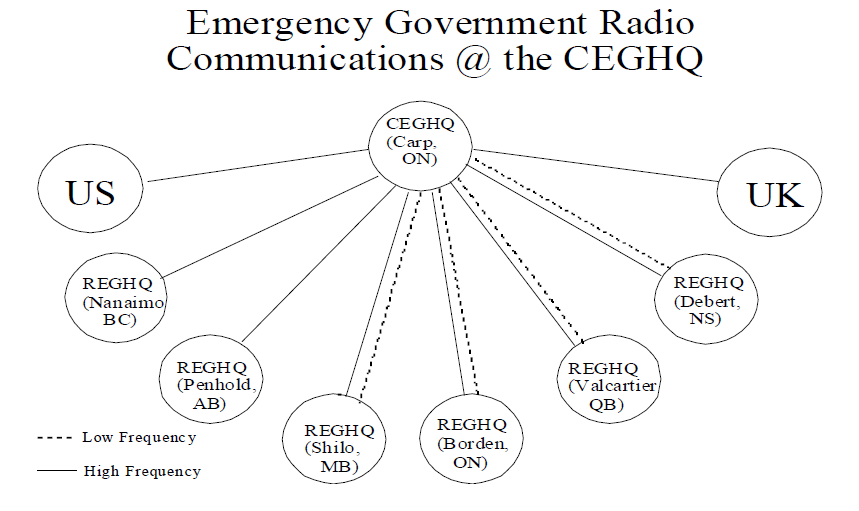
Emergency Government Radio Communications @ the CEGHQ
Dave Peters – The Diefenbunker, Canada’s Cold War Museum, (last revised Jan 2003)