
Originally BLOG # 3 – 14 Feb 2020 from davescoldwarcanada.com.
Good Afternoon Ladies and Gentlemen. I’m Dave Peters. I’ve been asked to say a few words about the war emergency purposes of the Diefenbunker, and to give you an idea of the activities took place there on a day to day basis. From 1982 to l997 I was a federal public servant with Emergency Preparedness Canada. EPC was the successor to the Canada Emergency Measures Organization, and the old Civil Defence Program. One of my duties was the management of the Continuity of Government Program. This place – Canadian Forces Station Carp or the Central Emergency Government Headquarters or the Diefenbunker as it was variously referred to, was an integral part of that program until about 1992.
The purpose of the Continuity of Government Program and the various bunkers that were part of the program was, and probably still is, widely misunderstood. One perception was that it would have provided a refuge for politicians and their families in a nuclear war. Another had it being some sort of Arc, a source of breeding stock for restoring the human species after a nuclear holocaust! The reality was of course quite different. It was to provide a fallout proof and in the case of this particular structure, blast resistant temporary safe location for a small number of federal and in the regions, provincial elected officials and their support staff. It was for those who had direct survival-of-the-nation responsibilities- and by the way without their families.
The aim was to ensure that there would be at least a thin thread of continuity of legally constituted Canadian government from before, to after a nuclear attack on North America. It was in places such as this that the situation would have been assessed and life and death decisions made affecting the survival of Canadians. The Diefenbunker was the flagship of the hierarchy of protected facilities and would have been the place from which central leadership would have been provided to the nation.
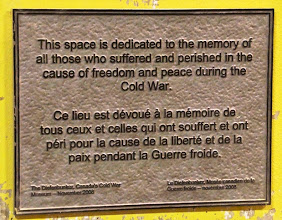
Memorial Plaque in the Bank of Canada Gold Storage Vault, Diefenbunker- Canada’s Cold War Museum, Ottawa, Canada
During its over three decades of existence this structure housed, on an ongoing, day-to-day basis, very important strategic telecommunications systems vital to the operational capability of the Canadian Forces. Over a hundred Canadian Forces women and men worked at CFS Carp. Their job was to operate the highly sophisticated equipment needed to provide this communications backbone. A small group of civilians supported that work, many of them local residents, and some of whom spent their entire career in the operation and maintenance of this facility.
Meanwhile some of us in Emergency Preparedness Canada and its predecessor, Canada EMO did our best to maintain the operational readiness of the various underground bunkers across the country. I say “did our best” because as the intensity of the Cold War ebbed and flowed over the years and the possibility of a nuclear attack on North America rose and fell with it, the resources to do the job varied as well. Nevertheless between the Department of National Defence, EPC and a few other departments and agencies, most of these protected facilities were kept at a reasonably good degree of preparedness for possible activation during the greater part of the program’s 30 years. As the location of the Central Emergency Government Headquarters, the Diefenbunker was maintained at a higher state of readiness than the rest.
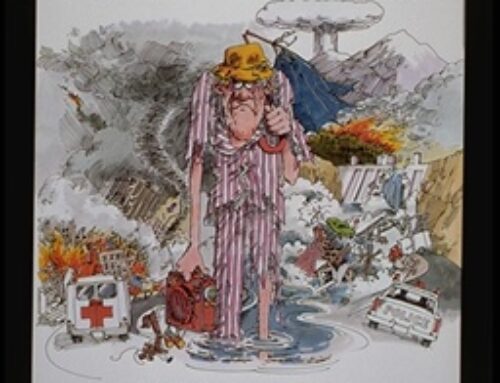
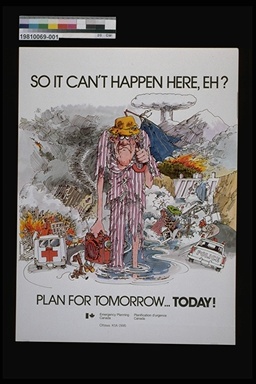
As the federal government’s temporary war headquarters the Diefenbunker was part of a wide spectrum of government plans and programs designed to help as many Canadians as possible survive a nuclear attack. Included were evacuation plans, home and community fallout shelter programs, a system of emergency hospitals, medical stores and treatment centres, a comprehensive system of warning and informing mechanisms including the network of alerting sirens and emergency broadcasting stations, as well as an array of public information publications and pre-recorded announcements that were kept ready for use – just in case. Policy and implementation concerning these and other response and recovery actions, plus a wide range of other related civil departmental and military decisions would have been coordinated from the Diefenbunker.
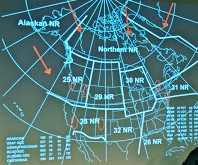
Iconorama Bomber Attack Simulation, Federal Warning Centre, Diefenbunker Museum
By virtue of its day to day operational role and the special telecommunications equipment in the bunker, the military personal of CFS Carp stood ready to support the government by providing a network of highly survivable communications within Canada and to our allies in North America and in Europe.
From time to time emergency preparedness officials and staff of many federal government departments and agencies held exercises where we practiced getting ready and responding to what we all knew was the unthinkable and hoped was the impossible. But it was one of our jobs and we tried to do it well.
While in my own mind I have always been convinced that, short of a nuclear winter situation occurring, many people would have survived and human kind would have continued. Millions would have died immediately and later untold millions would have suffered death and illness. Civilization would have staggered and reeled from the blows of nuclear attack and the deadly radioactive fallout that would have at least temporarily contaminated large parts of the land. Nothing would have ever have been the same again! But the instinct for survival would have carried us through – if and it is a very big if – that nuclear winter scenario did not take place.
Having some form of continuous government to plan and coordinate alerting, take cover, evacuation, rescue and recovery operations and to provide for at least minimal continuity of essential services would have surely enhanced the ongoing survival chances of those Canadians alive after the attack. That was the hope! That was the expectation!
But fortunately for us all, all of these preparations never had to be tested. A miracle occurred— the Cold War ended….and not with a bang! Very few foresaw it taking place the way it did but it actually happened.
We will never really know how close we came to Armageddon. But we should ensure that this period in Canada’s and the World’s history is not forgotten and thus repeated at some time in the future. This then is the purpose of the Diefenbunker, Canada’s Cold War Museum.
Thank you for joining us and I hope that you will encourage your families, friends and neighbours to come and visit and with us learn about this precarious era in our national and the world’s history.
(Dave Peters, was formerly an official with Emergency Preparedness Canada and for many years the senior official responsible for the civil readiness of Canada’s Emergency Government HQs )