Introduction:
The Berlin Wall was a barrier constructed by the German Democratic Republic (GDR, East Germany) in 1961, that completely cut off West Berlin from surrounding East Germany and from East Berlin. The wall was torn down in 1989 with the collapse of the Warsaw Pact.
The Inner German Border:
By the early 1950s, the Soviet approach to controlling national movement and restricting emigration, was emulated by most of the rest of the Eastern Bloc, including East Germany.
Up until 1952, the lines between East Germany and the western occupied zones could be easily crossed in most places. On 1 April 1952, East German leaders met with Soviet leader Joseph Stalin in Moscow and were advised to build up their border defenses.
As a consequence, the inner German border between the two German states was closed, and a barbed-wire fence erected. The border between the Western and Eastern sectors of Berlin, however, remained open, although traffic between the Soviet and the Western sectors was somewhat restricted. This resulted in Berlin becoming a magnet for East Germans desperate to escape life in the GDR.
In 1955, the Soviets gave East Germany authority over civilian movement in Berlin. Initially, East Germany granted “visits” to allow its residents access to West Germany. However, following the defection of large numbers of East Germans, virtually all travel to the West was restricted in 1956 and on 11 December 1957, East Germany introduced a new passport law that reduced the overall number of refugees leaving Eastern Germany.
This measure had the unintended result of drastically increasing the percentage of those leaving through West Berlin from 60% to well over 90% by the end of 1958. Those caught trying to leave East Berlin were subjected to heavy penalties, but with no physical barrier and subway train access still available to West Berlin, such measures were ineffective. The Berlin sector border was essentially a “loophole” through which Eastern Bloc citizens could still escape. The 3.5 million East Germans who had left by 1961 totalled approximately 20% of the entire East German population.
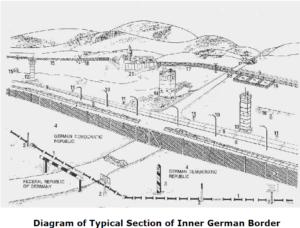
Diagram of Typical Section of Inner German Border
Construction of the Wall:
On Saturday, 12 August 1961, the leaders of the GDR attended a garden party at a government guesthouse in Döllnsee, in a wooded area to the north of East Berlin. There Ulbricht signed the order to close the border and erect a wall.
In a masterfully-planned operation, spanning just 24 hours, the streets of Berlin were torn up, barricades of paving stones were erected, tanks were gathered at crucial places and subways and local railway services were interrupted, so that within a day the West of Berlin was completely sealed off from the East. As of that same day inhabitants of East Berlin and the GDR were no longer allowed to enter the West part of the city (including the 60,000 who had been commuters). In response to international criticism that such drastic measures inevitably drew, the GDR claimed that the barricade had been raised as an ‘anti-fascist protection wall’, and that they had moved to prevent a third world war.
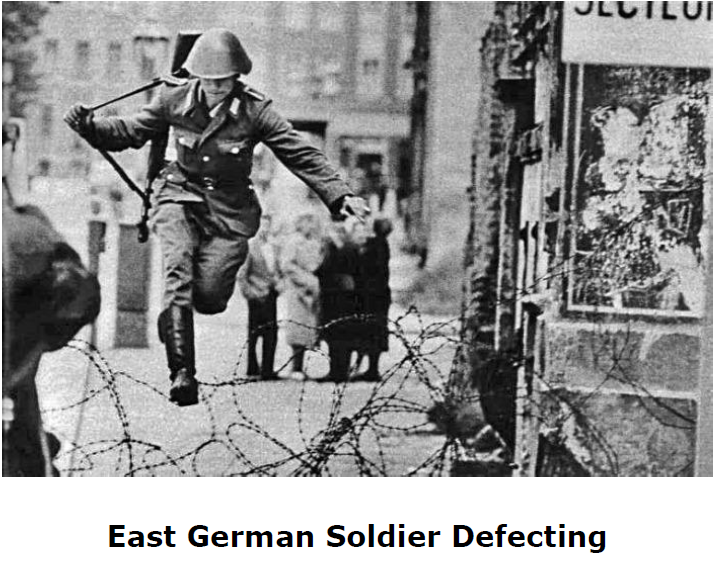
The barrier was built slightly inside East Berlin or East German territory to ensure that it did not encroach on West Berlin at any point. Later, it was built up into the Wall proper, the first concrete elements and large blocks being put in place on 17 August. During the construction of the Wall, East German soldiers stood in front of it with orders to shoot anyone who attempted to defect.
Additionally, chain fences, walls, minefields and other obstacles were installed along the length of East Germany’s western border with West Germany proper (the Inner German border). A huge no man’s land was cleared to provide a clear line of fire at fleeing refugees.
The creation of the wall had important implications for both German states. By stemming the exodus of people from East Germany, the East German government was able to reassert its control over the country. In spite of discontent with the wall, economic problems caused by dual currency and the black market were largely eliminated. The economy of the GDR began to grow. But, the wall proved a public relations disaster for the communist bloc. Western powers used it in propaganda as a symbol of communist tyranny, particularly after East German border guards shot and killed would-be defectors. Such fatalities were later treated as acts of murder by the reunified Germany.
The Wall:
The Berlin Wall was more than 140 kilometres (87 mi) long. In June 1962, a second, parallel fence some 100 metres (110 yd) farther into East German territory was built. The houses contained between the fences were rased and the inhabitants relocated, thus establishing what later became known as the Death Strip. The Death Strip was covered with raked sand or gravel, rendering footprints easy to notice, and easing the detection of trespassers. It offered no cover for potential defectors and offered clear fields of fire for the wall guards. Through the years, the Berlin Wall evolved through four versions:
- Wire fence (1961)
- Improved wire fence (1962–1965)
- Concrete wall (1965–1975)
- Grenzmauer 75 (Border Wall 75) (1975–1989)
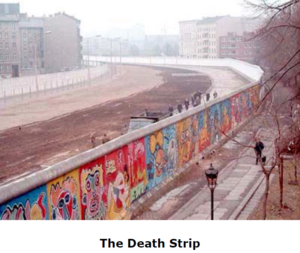
The Death Strip
The “fourth-generation wall”, was the final and most sophisticated version of the Wall. Begun in 1975 and completed about 1980 it was constructed from 45,000 separate sections of reinforced concrete, each 3.6 metres (12 ft) high and 1.2 metres (3.9 ft) wide, and cost DDM 16,155,000 or about US$3,638,000. The concrete sections were added to this version of the Wall to prevent escapees from driving their cars through the barricades. At strategic points the wall was constructed to a somewhat weaker standard so that East German and Soviet armored vehicles could break through easily in the event of war.
The top of the wall was lined with a smooth pipe, intended to make it more difficult to scale. It was reinforced by mesh fencing, signal fencing, anti- vehicle trenches, barbed wire, dogs on long lines, “beds of nails” under balconies hanging over the “death strip”, over 116 watchtowers, and 20 bunkers. The layout came to resemble the inner German border in most technical aspects, except the Berlin Wall had no landmines and no spring- guns.
Crossing Points:
There were nine border crossings between East and West Berlin, which allowed visits by West Berliners, West Germans, Western foreigners and Allied personnel into East Berlin, as well as visits by GDR citizens and citizens of other socialist countries into West Berlin, provided that they held the necessary permits. The most famous was the vehicle and pedestrian checkpoint at the corner of Friedrichstrasse and Zimmerstrasse, also known as Checkpoint Charlie, which was restricted to Allied personnel and foreigners.
After the 1972 agreements, new crossings were opened to allow West Berlin waste to be transported into East German dumps, as well as some crossings for access to West Berlin’s exclaves.
Four autobahns connected West Berlin to West Germany, the most famous being the Berlin-Helmstedt autobahn, which entered East German territory between the towns of Helmstedt and Marienborn (Checkpoint Alpha), and which entered West Berlin at Dreilinden (Checkpoint Bravo for the Allied forces) in southwestern Berlin. Access to West Berlin was also possible by railway (four routes) and by boat for commercial shipping via canals and rivers.
Non-German Westerners could cross the border at Friedrichstrasse station in East Berlin and at Checkpoint Charlie. When the Wall was erected, Berlin’s complex public transit networks, the S-Bahn and U-Bahn, were divided with it. Some lines were cut in half; many stations were shut down. Three western lines traveled through brief sections of East Berlin territory, passing through eastern stations (called Geisterbahnhöfe, or ghost stations) without stopping.
Defections:
During the years of the Wall, around 5,000 people successfully defected to West Berlin. The number of people who died trying to cross the wall, or as a result of the wall’s existence, has been disputed. The most vocal claims by Alexandra Hildebrandt, Director of the Checkpoint Charlie Museum and widow of the Museum’s founder, estimated the death toll to be well above 200. A historic research group at the Center for Contemporary Historical Research (ZZF) in Potsdam has confirmed 136 deaths. Prior official figures listed 98 as being killed.
East German Soldier Defecting
The Fall:
Hungary effectively disabled its physical border defenses with Austria on 19 August 1989 and, in September, more than 13,000 East German tourists escaped through Hungary to Austria. This set up a chain of events. The Hungarians prevented many more East Germans from crossing the border and returned them to Budapest. These East Germans flooded the West German embassy and refused to return to East Germany. The East German government responded by disallowing any further travel to Hungary, but allowed those already there to return. This triggered a similar incident in neighboring Czechoslovakia. On this occasion, the East German authorities allowed them to leave, providing that they used a train which transited East Germany on the way. This was followed by mass demonstrations within East Germany itself.
To ease the complications, the East German politburo decided on 9 November to allow refugees to exit directly through crossing points between East Germany and West Germany, including West Berlin. On the same day, the ministerial administration modified the proposal to include private travel. The new regulations were to take effect the next day.
Later that night West German radio proclaimed, “This is a historic day. East Germany has announced that, starting immediately, its borders are open to everyone. The GDR is opening its borders … the gates in the Berlin Wall stand open.”
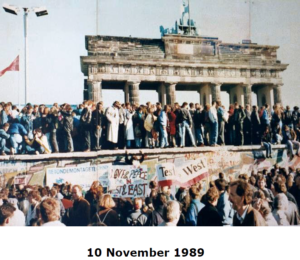
10 November 1989
After hearing the broadcast, East Germans began gathering at the wall and at the six checkpoints between East and West, demanding that border guards immediately open the gates. The surprised and overwhelmed guards made many hectic telephone calls to their superiors about the problem. It soon became clear that no one among the East German authorities would take personal responsibility for issuing orders to use lethal force, so the vastly outnumbered soldiers had no way to hold back the huge crowd of East German citizens. Finally, at 10:45 pm, the guards yielded, opening the checkpoints and allowing people through with little or no identity checking.
As the East Germans swarmed through, they were greeted by West Germans waiting with flowers and champagne amid wild rejoicing. Soon afterward, a crowd of West Berliners jumped on top of the wall, and were joined by East German youngsters. They danced together to celebrate their new freedom.
The date on which the Wall fell is considered to have been 9 November 1989 but the Wall in its entirety was not torn down immediately. Starting that evening and in the days and weeks that followed, people came to the wall with sledgehammers or otherwise hammers and chisels to chip off souvenirs, demolishing lengthy parts of it in the process and creating several unofficial border crossings. These people were nicknamed “Mauerspechte” (wall woodpeckers).
On 13 June 1990, the official dismantling of the Wall by the East German military began and lasted until November 1991. Only a few short sections and watchtowers were left standing as memorials.
The fall of the Wall was the first step toward German reunification, which was formally concluded on 3 October 1990.
On August 13 1998, a wall memorial was inaugurated at the Bernauer Strasse (at the corner to the Ackerstrasse, city districts Wedding/Mitte). It consists of a 70 m length of the Berlin wall.
 Captain (N) (Ret’d) M. Braham, CD – Mike Braham is a graduate of the Royal Military College (1965) and a former naval officer and senior official with DND. He has an abiding interest in military history.