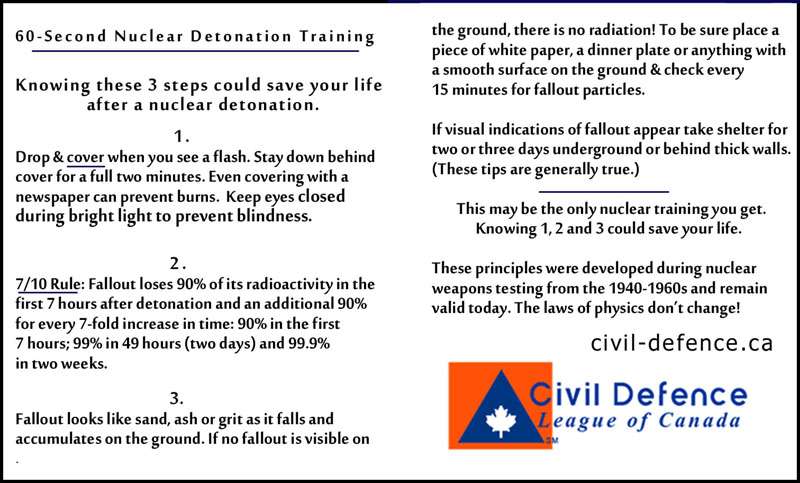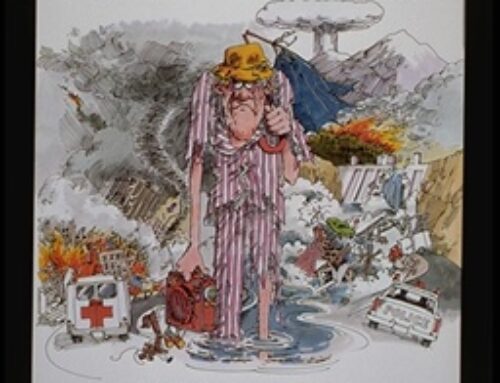
(Seriously, just open and peruse some of these below listed, curated, self-help and informative ‘oldy-but-goody” discussions and manuals for’ what about… and how to info…’ that could increase the possibility of you and your families’ survival after a nuclear war….ENJOY ? (P.S. WAIT for the download to complete and then open.)
11 Steps to Survival Blueprint for Survival No.4 (1969 – Emergency Measures Organisation Canada)
The classic Canadian CD pamphlet (originally designed with a hole punched in the upper left hand corner of it so you could handily hang it by your wall phone as opposed to stick it in a drawer where it would lie forgotten!). Good information, well presented.
Fallout on the Farm Blueprint for Survival No.3 (April 1961 – Agriculture Canada)
1961 CD pamphlets with practical (and not so practical) tips ‘dealing’ with fallout on Canadian Farms.
Surviving A Nearby Tactical Nuclear Weapon Detonation (anonymous)
Home Defence and the Farmer (July 18, 2000 – United Kingdom Home Office)
“The continuance of food production on farms affected by fallout could well depend upon the practical steps taken by each farmer and staff at a time when they would be on their own, with no one to turn to for advice or help. Although mainly concerned with farming matters, the handbook also deals briefly with the danger to the farmer and their families from radioactive fall-out and how they might protect themselves.”
ABOVEGROUND HOME FALLOUT SHELTER (November 1983 – Federal Emergency Management Agency manual H-12-2)
Your Basement Fallout Shelter Blueprint for Survival No.1 (1961 – Emergency Measures Organization Canada)
BELOWGROUND HOME FALLOUT SHELTER (November 1983 – Federal Emergency Management Agency manual H-12-1)
“This family fallout shelter, designed primarily for homes without basements, is a permanent home shelter to be placed in the yard. It is designed to have a protection factor of at least 40, which is the minimum standard of protection for public shelters throughout the United States. This assures that persons inside the shelter will be protected against radioactive fallout following a nuclear attack, and will also have protection against earthquakes, hurricanes and tornadoes.”
You Will Survive Doomsday – 23 Myths of Nuclear War (March 12, 2000 – Bruce Beach*)
“Our purpose in publishing this document is to ameliorate the effects of a nuclear holocaust for as many people as we can reach, and to locate as many people as we can who are willing and able to join our nuclear survival group.” *Bruce Beach, was retired researcher who lived in the village of Horning’s Mills, Ontario who was preparing for a nuclear war by building a underground shelter for children and teens to stay and survive throughout the fallout period. This “underground orphanage” was named “Ark Two” based on the story of “Noah’s Ark” . See the Wikipedia article on Mr. Beach and the Ark Two Shelter. Bruce Beach died in 2021 at the age of 87 still pursuing his dreams (one of which was this underground shelter in Horning’s Mills, Ontario). RIP Bruce.
Domestic Nuclear Shelters ( July 18, 2000 – United Kingdom Home Office)
“This booklet is a brief guide to three basic kinds of nuclear shelter:
1. Simple shelters for short-term indoor or out-door use which can be built from materials already at hand, 2. Shelters that can be assembled from do-it-yourself kits, 3. Permanent custom-built shelters built into the ground and requiring professional help in design and
construction.”
Nuclear War Survival Skills (1987 – Oregon Institute of Science and Medicine & Oak Ridge National Laboratory – Cresson H. Kearny)
‘The purpose of this book is to provide Americans and other unprepared people
with information and self-help instructions that will significantly increase their
chances of surviving a nuclear attack. It brings together field- tested instructions
that, if followed by a large fraction of Americans during a crisis that precedes an
attack, could save millions of lives.”…..
Life After Doomsday – A Survivalist Guide to Nuclear War and Other Major Disasters (1979 – Bruce D. Clayton Ph.D.)
Whether you agree with the author or not, this is an illuminating read for the basic information it contains about the effects of nuclear weapons and what can be done to attempt to survive in the aftermath of a nuclear war.
A HOMEMADE FALLOUT METER, THE KFM – HOW TO MAKE AND USE IT (1998 – CH Kearny)
“Untrained families, guided only by these written instructions and using only low cost materials and tools found in most homes, have been able to make a KFM by working 3 or 4 hours. By studying the operating sections of these instructions for about 1 & 1/2 hours, average untrained families have been able to successfully use this fallout meter to measure dose rates and to calculate radiation doses received, permissible times of exposure, etc.”
Survival in Likely Target Areas Blueprint for Survival No. 5 (1962 – Government of Canada – Mount Royal University Archives & Special Collections)
And some useful links…
Nuclear War Survival — How To Survive a Nuclear War
Fred Armbruster , the founder of the Canadian Civil Defence Museum has assembled an amazingly complete collection of pertinent-to-the-Cold-War “Civil Defence” era pamphlets on his Canadian Civil Defence Museum website. See below for a sample:
Finally… PRINT THIS AND KEEP IT HANDY